

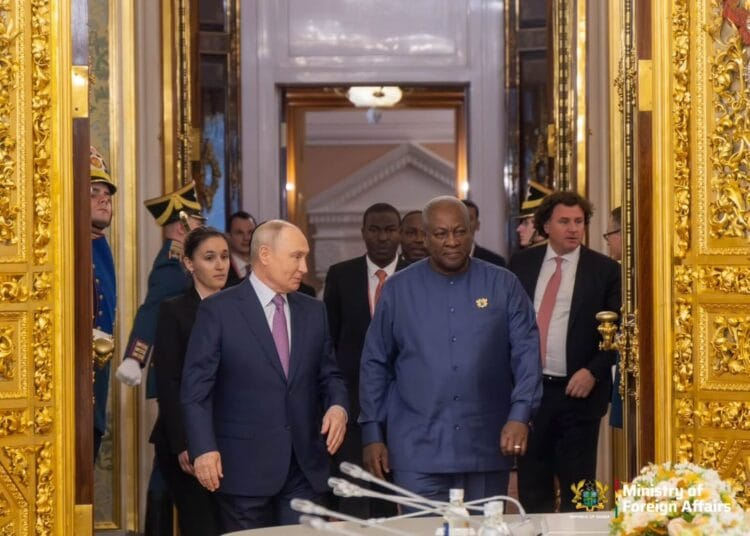
Ghana’s long-standing ambition to develop nuclear power has gained fresh momentum following high-level discussions between President John Dramani Mahama and Russian President Vladimir Putin, with Moscow expressing readiness to cooperate with Accra on a proposed 2,000-megawatt (MW) nuclear power facility.
The development, announced by Ghana’s Foreign Affairs Minister, Samuel Okudzeto Ablakwa, after the Russia-Africa Summit, signals a renewed push to incorporate nuclear energy into the country’s long-term electricity generation strategy.
In a statement communicating the outcome of the presidential engagement, Mr Ablakwa said Russia had agreed to work with Ghana towards establishing the proposed facility.
“Russia has agreed to work with Ghana to establish a 2,000 megawatts nuclear power plant to guarantee energy security and anchor industrialization,” he stated.
The proposed project, if realised, would mark a major development in Ghana’s efforts to diversify its energy mix, strengthen electricity security and provide the power required to support industrial expansion.
It would also represent a significant step towards reviving a national aspiration that dates back to the administration of Ghana’s first President, Osagyefo Dr Kwame Nkrumah.
However, while Russia’s commitment provides important political momentum, the announcement does not yet constitute a final construction or investment agreement. Key details, including project financing, technology selection, site location, implementation timelines and the respective responsibilities of both countries, remain to be established.
Revisiting Nkrumah’s Nuclear Energy Vision
Ghana’s nuclear ambitions have historical roots in Nkrumah’s development philosophy, which placed considerable emphasis on science, technology and industrialisation as foundations for national transformation.
His administration explored nuclear technology as part of a broader strategy to position Ghana as a technologically advanced and industrialised economy. However, the military coup of February 28, 1966, interrupted the country’s early nuclear development aspirations.
Mr Ablakwa has characterised the latest engagement with Russia as a revival of that historical ambition.
“A revival of Osagyefo Kwame Nkrumah’s vision,” he described the proposed initiative.
The renewed interest therefore connects Ghana’s historical nuclear aspirations with contemporary efforts to address the country’s growing electricity requirements and industrial development needs.
Over the years, successive governments have maintained interest in nuclear power as a potential component of Ghana’s future generation portfolio, recognising the need for a diversified and dependable electricity supply.
The latest announcement could provide the political impetus needed to accelerate the process, although translating that ambition into an operational nuclear facility will require sustained institutional commitment and considerable technical and financial preparation.
Why Ghana Is Looking At 2,000MW Of Nuclear Power
The proposed 2,000MW capacity represents a substantial generation investment with potentially far-reaching implications for Ghana’s electricity sector.
One of the principal attractions of nuclear energy is its ability to generate large volumes of electricity continuously, independently of weather conditions that can affect solar and hydropower generation.
Unlike some renewable energy sources, nuclear power can provide stable baseload electricity, making it a potential contributor to the reliability of national electricity systems.
For Ghana, this characteristic is particularly important as the country pursues industrialisation, expands manufacturing and seeks to increase domestic processing and value addition across strategic sectors.
Mining, aluminium production, petrochemicals, manufacturing and other energy-intensive industries require substantial and dependable electricity supplies. Uncertainty over power availability and pricing can affect production costs, investment decisions and industrial competitiveness.
A nuclear power facility could therefore contribute to addressing the country’s long-term energy requirements while supporting the government’s broader industrial transformation agenda.
Nevertheless, the proposed 2,000MW capacity will need to be assessed against projected electricity demand, existing generation resources, future supply requirements and the capacity of the national transmission network.
The integration of such a large generation facility would also require substantial planning to ensure that electricity can be transmitted efficiently to industrial and residential demand centres.
Beyond generation, the project would have implications for transmission infrastructure, electricity market arrangements, regulatory oversight and the financial sustainability of the power sector.
The Financing And Technical Questions Ahead
Despite the significance of Russia’s stated willingness to cooperate, the proposed nuclear project remains at an early stage of definition, with several critical issues requiring clarification.
Nuclear power development is among the most capital-intensive forms of energy infrastructure. Projects of this nature require substantial upfront investment, long development periods and extensive technical preparation before construction can begin.
Financing arrangements will therefore be central to determining the project’s viability.
Ghana will need to establish whether the proposed partnership will involve direct government financing, concessional lending, private-sector participation, a build-operate arrangement or another investment structure.
The choice of reactor technology, construction costs, fuel supply arrangements, operational responsibilities and long-term maintenance obligations will also be important considerations.
Equally critical will be the country’s regulatory and institutional preparedness.
Nuclear power development requires a robust independent regulatory system, qualified technical personnel, stringent safety standards and effective environmental protection measures. Arrangements for radioactive waste management, emergency preparedness and nuclear security must also be clearly established.
Ghana’s existing nuclear institutions and regulatory framework will consequently have important roles to play in determining the country’s readiness to move from planning to implementation.
Although Russia has considerable experience in nuclear technology and power plant development, the precise structure of its proposed cooperation with Ghana has not yet been outlined.
The next phase of engagement will therefore need to establish the technical, commercial and institutional framework governing the partnership.
Nuclear Energy And The Industrialisation Agenda
The proposed facility also reflects the growing recognition that Ghana’s industrial ambitions will require a more diversified and dependable electricity generation portfolio.
The country’s electricity supply currently draws substantially from thermal and hydropower, complemented by a smaller contribution from renewable energy sources.
Introducing nuclear generation would add another major source to the mix and potentially strengthen the resilience of the electricity system.
For an economy seeking to expand manufacturing, develop its mineral resources and increase domestic processing, reliable electricity is a critical requirement.
The processing of minerals into higher-value products, for instance, can require significantly more electricity than the extraction and export of raw materials.
Similarly, the development of petrochemical industries, large-scale manufacturing and other industrial activities will depend on long-term confidence in electricity availability, reliability and pricing.
Nuclear energy could help provide that stability, provided the project is implemented at a commercially sustainable cost and supported by adequate transmission and distribution infrastructure.
However, the economic case for the proposed plant must extend beyond its generating capacity.
The government will need to determine whether the electricity produced can be supplied at competitive tariffs without placing additional financial pressure on consumers, electricity distributors or public finances.
The long construction period and significant capital requirements associated with nuclear infrastructure also mean that the project must be considered within a comprehensive national energy investment strategy.
A Strategic Partnership With Long-Term Implications
The emerging cooperation with Russia could open another chapter in Ghana’s energy and diplomatic relations with Moscow.
Beyond the potential construction of a nuclear facility, the partnership could create opportunities for technology transfer, specialised training, research, local capacity development and the preparation of Ghanaian professionals for the operation and maintenance of nuclear infrastructure.
Developing a domestic nuclear workforce will be particularly important if Ghana intends to operate a nuclear power programme over several decades.
The country will require nuclear engineers, radiation protection specialists, safety inspectors, plant operators and other highly specialised professionals.
Local participation in construction, engineering services and supporting industries could also create opportunities for Ghanaian businesses, depending on the eventual structure of the project.
However, the extent of these benefits will depend on the terms negotiated between the two countries and the level of local content incorporated into the implementation framework.
For Ghana, ensuring that the partnership delivers lasting technical and economic benefits will be as important as securing the nuclear technology itself.
The Road From Ambition To Implementation
Russia’s willingness to cooperate on a proposed 2,000MW nuclear power facility gives Ghana’s nuclear programme renewed political visibility and places the initiative firmly within the country’s broader energy security and industrialisation agenda.
It also revives an important chapter in Ghana’s development history, reconnecting the nuclear aspirations of Nkrumah’s era with a contemporary effort to secure reliable electricity for future generations.
Yet the ultimate success of the initiative will not be determined by diplomatic commitments or historical symbolism alone.
The decisive factors will be the availability of sustainable financing, the suitability of the selected technology, regulatory preparedness, nuclear safety, environmental safeguards and the ability to integrate the facility into Ghana’s electricity system.
The government must also demonstrate that the investment represents value for money and will not undermine the financial stability of the country’s already challenged power sector.
For now, the proposed 2,000MW facility represents a potentially transformative ambition rather than a project ready for construction.
The next phase of Ghana-Russia engagement will be crucial in determining whether the renewed nuclear partnership can progress from political commitment to a bankable, technically sound and commercially viable investment.
For a country whose nuclear ambitions date back to the Nkrumah era, the challenge is no longer simply to revive the vision, but to build the institutional, financial and technical foundations required to finally realise it.
I have restructured the article, removed the repeated sections, changed the headline and rewritten the narrative to give it a distinct editorial identity while retaining the central facts, historical context and analytical depth.
Leave a Reply