

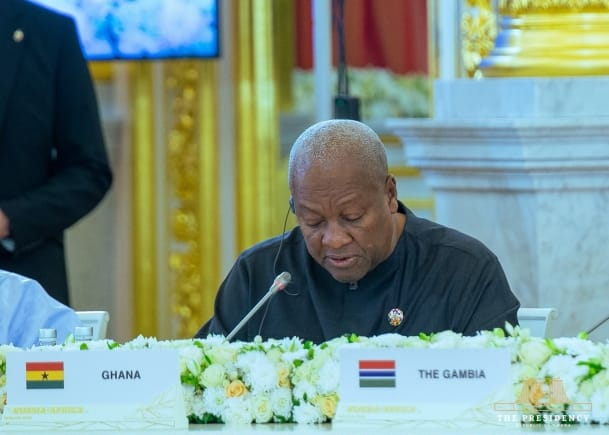
Ghana has opened discussions with Russia’s state-owned nuclear energy corporation, Rosatom, towards the establishment of the country’s first nuclear power plant, President John Dramani Mahama has announced.
President Mahama disclosed this on Thursday, October 30, 2026, during his address at the Third Russia–Africa Summit in Moscow, where he outlined Ghana’s plans to diversify its energy sources to support industrialisation and long-term economic growth.
He said the proposed nuclear power project formed part of Ghana’s broader strategy to develop a balanced energy mix, combining conventional generation, renewable energy and nuclear power to meet the country’s growing electricity demand.
“We have initiated discussions with Rosatom on the establishment of Ghana’s first nuclear power station,” President Mahama told the gathering of African leaders and Russian officials, chaired by Russian President Vladimir Putin.
He also recalled Ghana’s longstanding nuclear research cooperation with the Soviet Union, which supplied the country with a two-megawatt research reactor in 1964. The reactor, located at the Ghana Atomic Energy Commission (GAEC) in Kwabenya, has since played a significant role in nuclear research, training and the peaceful application of nuclear technology.
Ghana’s Nuclear Power Ambitions
Ghana’s pursuit of nuclear power dates back several decades, as successive governments have explored the technology as a potential solution to the country’s long-term electricity needs.
The country established its Nuclear Power Institute under the Ghana Atomic Energy Commission to coordinate research and preparations towards introducing nuclear electricity generation.
The government has also been working towards the development of the institutional, regulatory and technical framework required for a nuclear power programme, with the Nuclear Regulatory Authority responsible for ensuring nuclear safety, security and safeguards.
Ghana considers nuclear energy a potential source of reliable baseload electricity, particularly as demand for power increases alongside efforts to expand industrial production, mineral processing and other energy-intensive economic activities.
The proposed engagement with Rosatom could provide an opportunity for Ghana to explore Russian expertise in nuclear technology, infrastructure development, financing and technical cooperation.
However, the development of a nuclear power plant will require substantial investment, comprehensive safety assessments, regulatory compliance, skilled human resource development and long-term arrangements for nuclear waste management.
Mahama Seeks Broader Economic Cooperation
Beyond nuclear energy, President Mahama used the summit to call for stronger economic and financial cooperation between Africa and Russia, particularly through the use of local currencies and digital payment systems to facilitate legitimate trade.
He also invited Russian businesses to partner with Ghanaian companies in key sectors, including agro-processing, fertiliser production, pharmaceuticals and transport infrastructure.
The President’s engagement with Rosatom signals another step in Ghana’s longstanding ambition to introduce nuclear-generated electricity into its national energy mix, as the country explores alternative sources of dependable power to support its industrialisation agenda.
Leave a Reply