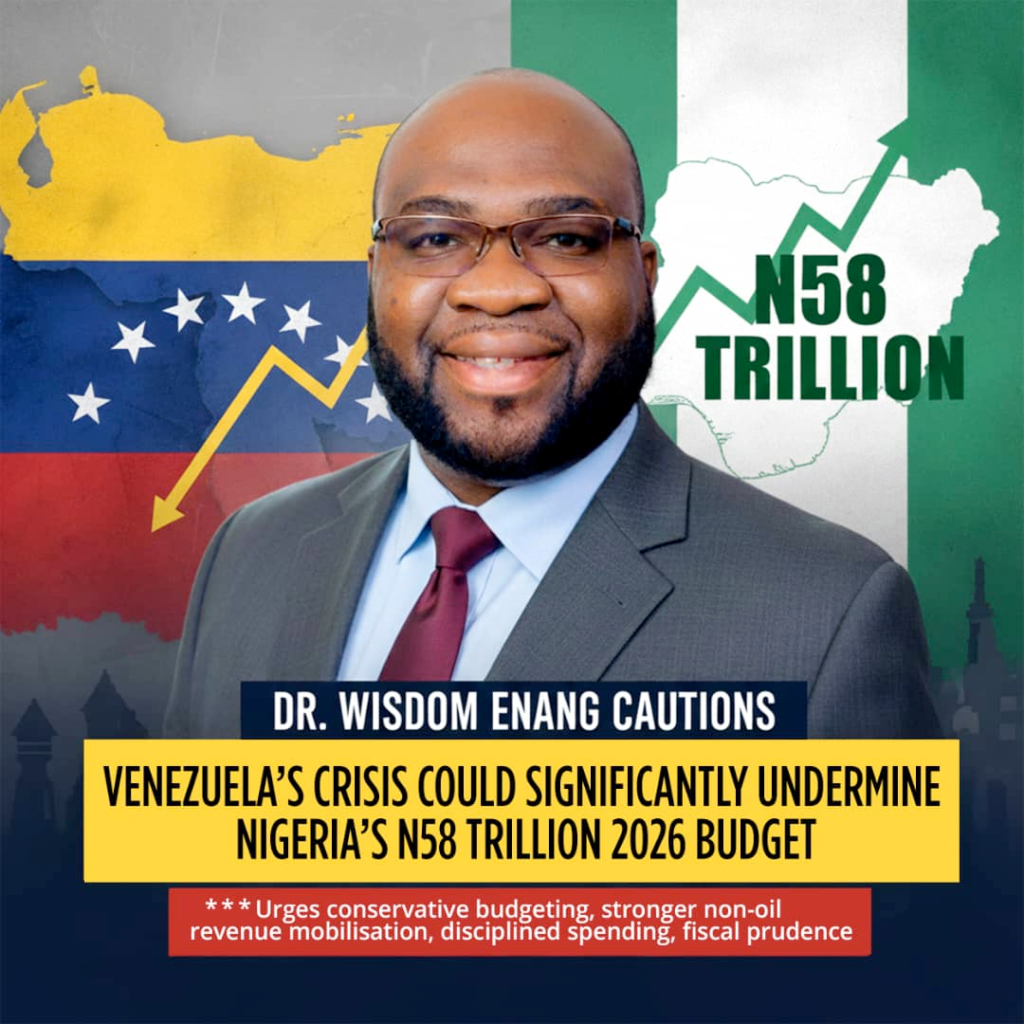


- Urges conservative budgeting, stronger non-oil revenue mobilisation, disciplined spending, fiscal prudence
An Adjunct Professor of the North Dakota University, USA, and a globally respected oil and gas consultant, Engr. (Dr.) Wisdom Patrick Enang, has warned that unfolding geopolitical developments in Venezuela could materially undermine Nigeria’s ₦58.18 trillion 2026 Federal Government budget by exerting sustained downward pressure on global crude oil prices.
Dr. Enang made this known on Friday, January 16, in Uyo, the Akwa Ibom State capital, during an interaction with journalists, noting that shifts in global oil supply dynamics are already forcing a reassessment of fiscal projections across oil-dependent economies, with Nigeria particularly exposed to downside risk.
In his opening remarks, the ebullient energy expert, who advises several local and international energy companies, observed that the Venezuelan crisis has triggered a recalibration of market expectations, placing Nigeria’s core budget assumptions under heightened scrutiny at a time when oil market sentiment is becoming increasingly cautious rather than optimistic.
According to him, President Donald Trump’s long-stated preference for crude oil prices around $50 per barrel is no longer an abstract political signal but an emerging market reality shaped by evolving United States foreign policy priorities and a broader supply-side reconfiguration.
“Nigeria is budgeting on a best-case oil scenario in a market that is increasingly pricing in downside risk.”
Expanding on this, Dr. Enang explained that the Federal Government expects to generate approximately $40.6 billion in oil revenue in 2026 by producing about 673 million barrels of crude, equivalent to 1.84 million barrels per day, at a benchmark price of $64.85 per barrel, although the National Assembly has proposed a downward revision of the benchmark to $60 per barrel.
He cautioned that should oil prices retreat to $50 per barrel, Nigeria could suffer a revenue shortfall of roughly $10.24 billion, a shock that would significantly strain fiscal execution and widen already existing funding gaps.
“Oil price sensitivity is no longer theoretical. Every dollar drop below benchmark now has immediate fiscal consequences.”
Dr. Enang recalled that following reports of a United States-backed military intervention in Venezuela and the capture of President Nicolas Maduro, President Trump publicly indicated that his administration would invest heavily in reviving Venezuelan oil production, signalling the potential return of substantial Venezuelan crude volumes to the global market.
The economic egghead further noted that eight major producers: Saudi Arabia, Russia, Iraq, the United Arab Emirates, Kuwait, Kazakhstan, Algeria and Oman, have reaffirmed their commitment to OPEC-backed market stability, citing a steady but fragile global economic outlook.
He however warned that even with OPEC intervention, the re-entry of Venezuelan oil could tilt the balance in an already delicate market, particularly if global demand growth remains muted.
“OPEC can manage volatility, but it cannot repeal economics.”
With oil revenue forming a central pillar of Nigeria’s ₦58.18 trillion spending plan, Dr. Enang disclosed that stakeholders are increasingly concerned that a faster-than-expected rehabilitation of Venezuela’s oil sector could weaken Nigeria’s fiscal projections, reduce foreign exchange inflows and deepen existing revenue constraints.
He described the $64.85 per barrel benchmark as optimistic though not impossible, but stressed that prudence demands more conservative assumptions in a volatile global market increasingly shaped by geopolitics and supply management.
This concern, he emphasised, is amplified by Nigeria’s existing fiscal fragility, noting that the Federal Government recorded a revenue shortfall of nearly ₦30 trillion in 2025, exposing a persistent disconnect between budget expectations and actual inflows.
The Fellow of both the Nigerian Society of Engineers and the Nigerian Institution of Safety Engineers further warned that the naira could again face downward pressure if oil receipts weaken.
“The exchange rate does not strengthen on sentiment. It strengthens on dollars. Oil still supplies most of those dollars.”
Dr. Enang further explained that the 2026 budget framework estimates total expenditure of ₦58.18 trillion, comprising ₦15.52 trillion for debt servicing, ₦15.25 trillion for non-debt recurrent expenditure and ₦26.08 trillion allocated to capital spending.
He noted that the projected fiscal deficit of ₦23.85 trillion, equivalent to about 4.28% of GDP, leaves little room to absorb adverse oil price shocks, particularly given that oil production assumptions remain ambitious.
Nigeria, he observed, has consistently struggled to meet its production targets due to chronic under investment, oil theft, pipeline vandalism, operational inefficiencies and declining output from mature fields.
“The production target of 1.84 million barrels per day remains aspirational, even before accounting for external shocks.”
“If oil prices fall to $59 per barrel, projected gross revenue would decline to roughly $33.6 billion, intensifying borrowing pressures and constraining budget execution.”
Providing further context, the revered policy strategist explained that Venezuela’s production collapse over the past decade was driven less by resource scarcity than by sanctions-related compliance risks that forced the exit of traders, insurers, banks and shipping firms.
“Before 2019, Venezuela exported over 700 million barrels annually. Sanctions, not reserves, broke that system.”
“Any easing of sanctions and restoration of legal certainty could allow Venezuelan crude to re-enter mainstream global markets, expanding supply and exerting renewed downward pressure on prices.”
“For Nigeria, the risk is not immediate displacement, but price compression in a highly competitive market.”
From a pricing outlook standpoint, the Akwa Ibom born, United Kingdom-trained Chartered Engineer projected that crude oil prices could hover around $50 per barrel in 2026, particularly if Venezuelan exports recover faster than expected and global economic growth remains subdued.
“Nigeria and Venezuela sell into similar markets. That makes them competitors, not spectators.”
The reform-focused analyst further cautioned that Nigeria’s continued reliance on exporting crude while importing refined products remains economically inefficient, urging the Federal Government to resolve longstanding refinery challenges, support private refining capacity and divert more crude into domestic processing.
Lower oil prices, he added, would weaken Nigeria’s foreign exchange position, reduce dollar inflows and complicate efforts to stabilise the naira, especially ahead of the 2027 general elections when fiscal and foreign exchange pressures typically intensify.
Dr. Enang also warned that a rehabilitated Venezuelan oil sector could divert global investment capital away from Nigeria and other African producers at a time when Nigeria urgently requires fresh capital to arrest production decline.
“If Venezuela is de-risked, capital will flow. Capital is not sentimental.”
While acknowledging Nigeria’s tax reform programme launched in January 2026, the Ethical and Attitudinal Reorientation Czar cautioned that structural reforms take time to yield results and cannot immediately offset oil revenue shocks, particularly with debt servicing already consuming over a quarter of total expenditure.
He concluded that without more conservative budgeting, stronger non-oil revenue mobilisation and tighter spending discipline, Nigeria’s ₦58.18 trillion 2026 budget could face significant implementation challenges in an increasingly uncertain global oil market.