

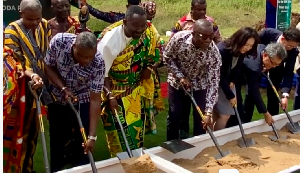
John Abdulai Jinapor, Minister of Energy and Green Transition, has cut the sod for the construction of a 1MW solar power plant at the Dawhenya Irrigation Scheme in the Greater Accra Region to boost agricultural production. The project forms part of the Korean Government–funded Water-Energy-Food Nexus Project (WEFP), being implemented by the Ministry of Energy and Green Transition (MoEn>) in collaboration with the Korean Association of Machinery Industry (KOAMI). Other partners are the Ministry of Finance, Energy Commission, Electricity Company of Ghana (ECG), and the Ghana Irrigation Development Authority (GIDA) under the Ministry of Food and Agriculture. Speaking at the ceremony on Friday, Jinapor described the initiative as “a foundation for innovation, sustainability, and prosperity for generations to come,” stressing its role in addressing the twin challenges of energy transition and food security. “Without clean, affordable, and reliable energy, irrigation systems cannot function; without water, we cannot grow food; and without food, our people cannot thrive,” he said.
The Minister said the plant would provide reliable power for irrigation, reduce dependence on costly diesel generators, and boost rice production and food security in Dawhenya and beyond. It would also lower greenhouse gas emissions in line with Ghana’s Nationally Determined Contributions (NDCs) and create green jobs for youth and women in agriculture and renewable energy. The project, estimated at $5 million, covers construction, training of MoEn> staff on operation and management of the plant, and other technical assistance. It is expected to be completed within eight to twelve months. Jinapor observed that Ghana’s dependence on rain-fed agriculture remained a major setback. While South Korea had irrigated over 800,000 hectares and partially irrigated 200,000 hectares of farmland as far back as 2009, Ghana irrigates only about three per cent of its cultivated land, despite irrigation potential of between 360,000 and 1.9 million hectares. He noted that food inflation had been a key driver of Ghana’s overall 23.8 per cent consumer price inflation in 2024, citing rising costs of staples such as rice, yam, and tomato. The Minister outlined government’s target of bringing more than one million hectares under irrigation in the next five years, beginning with the deployment of 400 solar water pumps in 2026, and scaling up to 3,500 pumps by 2028 to irrigate about 400,000 hectares. He assured that the Ministry was working with the Ministry of Finance to secure tax exemptions on imported materials and equipment for the plant and urged the Renewable Energy and Green Transition Directorate to ensure timely completion.
The minister appealed to farmers and residents of Dawhenya to take ownership of the facility and safeguard it, adding that encroached irrigation lands must be reclaimed for their intended agricultural use. Madam Kim Hyunjoo, Second Secretary at the Embassy of the Republic of Korea, said the project was more than just a source of clean energy, stressing its direct link to both Ghana’s “Feed Ghana” Programme and Korea’s “K-Rice Belt” initiative.