

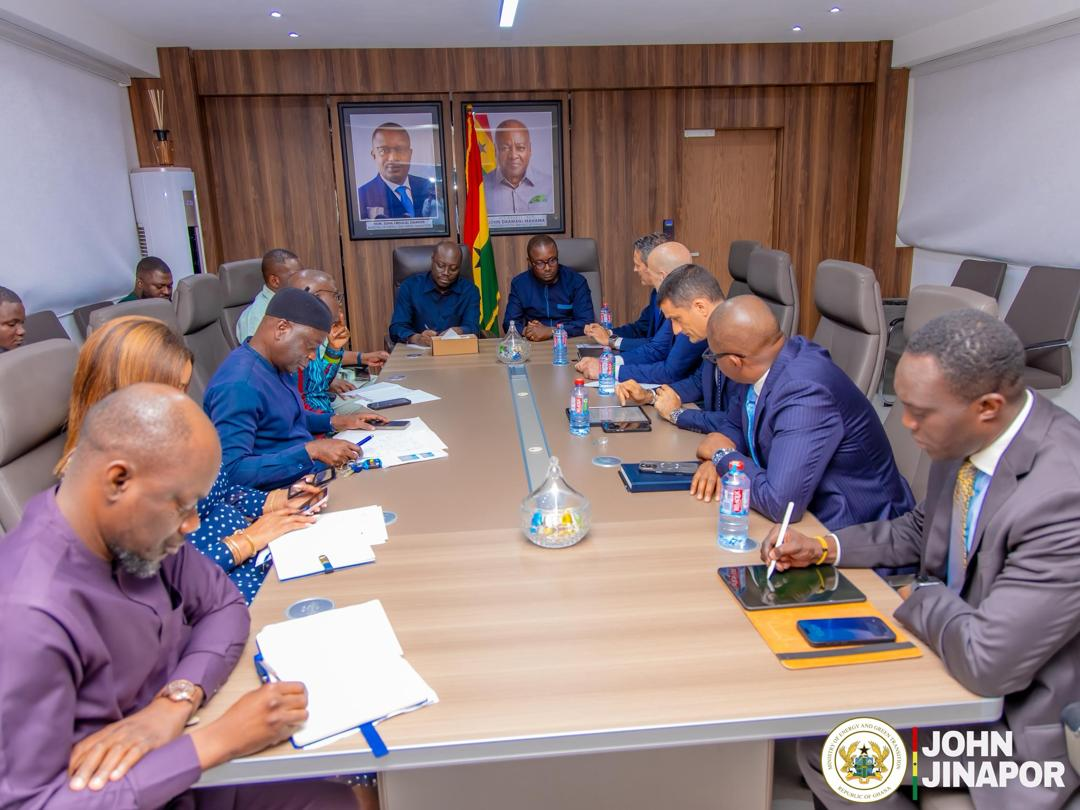
Global energy major ENI has reaffirmed its commitment to expanding operations in Ghana, commending the government for creating a stable, transparent, and investor-friendly environment that continues to attract global capital into the energy space.
The show of confidence came during a high-level engagement in Accra with Ghana’s Minister for Energy and Green Transition, Hon. John Abdulai Jinapor; Finance Minister, Hon. Dr. Cassiel Ato Forson; and Minister for Roads and Highways, Hon. Kwame Governs Agbodza. The meeting focused on deepening cooperation, reviewing current operations, and charting new investment pathways in the upstream petroleum sector.
A key takeaway from the discussions was ENI’s announcement of a significant increase in natural gas production to 270 million standard cubic feet per day (mmscfd) a critical boost for Ghana’s energy security and industrial growth.
ENI officials praised Ghana’s regulatory clarity and pro-investment approach, describing it as essential to long-term resource development. The company also disclosed plans to inject further capital into the country’s upstream oil and gas sector, expressing optimism about the long-term prospects of Ghana’s energy market.
Energy Minister Jinapor welcomed ENI’s commitment and highlighted the company’s recent declaration of commerciality as a key milestone. “This is a strong endorsement of Ghana’s energy potential,” he said. “The past six months have seen more progress than the last eight years. ENI’s performance is driving new investor interest and bolstering confidence in the sector.”
Finance Minister Dr. Forson also hailed ENI’s resilience and long-term vision, especially in navigating past sectoral challenges. He assured the company of robust government support, including plans to reinstate a US$500 million partial risk guarantee by early 2026 to ensure timely payments and reduce investor risk.
“We are committed to building a financial framework that sustains growth and confidence,” Dr. Forson noted, while encouraging ENI to accelerate exploration and production in support of Ghana’s goal to ramp up oil output to 500,000 barrels per day in the near term.
The meeting signaled a renewed momentum in Ghana’s energy diplomacy, anchored on mutual trust, shared growth ambitions, and a strategic push to position the country as a leading hydrocarbons hub in the region.