

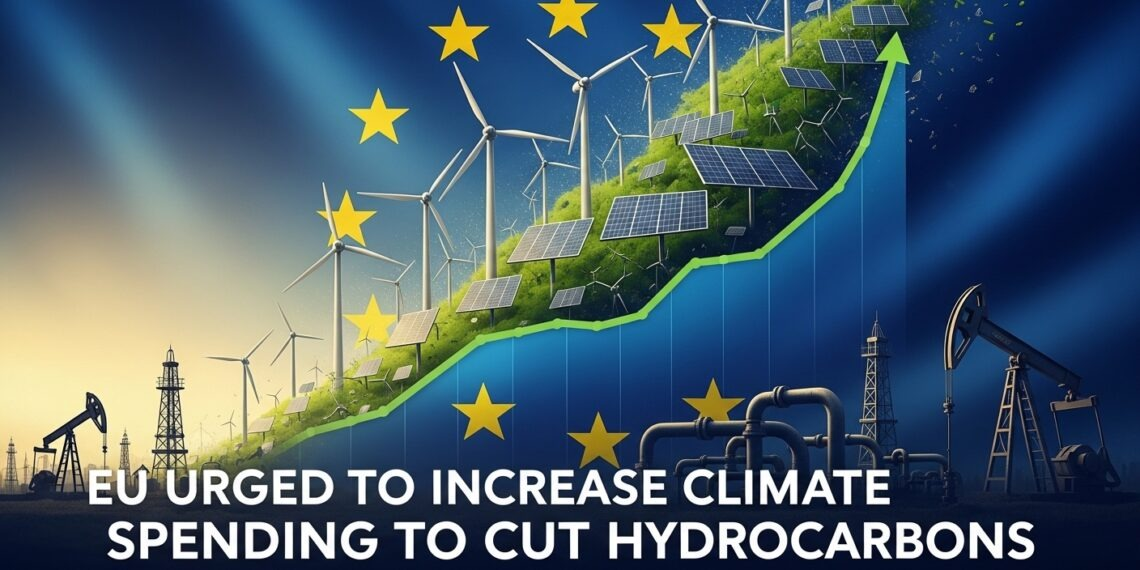
The European Union must significantly increase climate spending to accelerate its shift away from hydrocarbons, according to a new warning from the European Union Scientific Advisory Board on Climate Change.
The advisory body argues that Europe’s status as the fastest-warming continent underscores the urgency of deeper mitigation and adaptation measures. With the growing frequency of extreme weather events already inflicting heavy economic and human costs, the board says current efforts remain insufficient to shield the bloc’s economies and citizens from escalating climate risks.
Citing data from the World Meteorological Organization, the report highlights a surge in extreme events such as floods, droughts and heatwaves across Europe.
The Scientific Advisory Board reported that “weather- and climate-related extreme events are already causing severe losses across Europe.”
It noted that extreme heat alone has resulted in tens of thousands of premature deaths in recent years, including an estimated 24,000 fatalities during the summer of 2025.
Beyond the human cost, the economic impact is mounting sharply. The board estimates that annual economic damage from climate-related events now stands at approximately €45 billion, or over $53 billion. This represents a fivefold increase compared to the 1980s, even though the EU was smaller at the time.
Such figures, the board warned, are not merely statistics but indicators of structural vulnerability within Europe’s economic framework.
Competitiveness and Security at Risk
In its assessment, the advisory body cautioned that unchecked climate impacts could weaken Europe’s global competitiveness and strain public finances.
“This could increasingly weaken Europe’s competitiveness, strain public budgets, and increase security risks,” the board stated. It further warned that without adequate adaptation, climate impacts would compound over time, “eroding and destabilising Europe’s economic and social foundations.”
The board added that despite ongoing initiatives, adaptation efforts so far “remain insufficient to prevent avoidable impacts and to manage escalating climate risks.”
The warning comes at a time when European governments are grappling with fiscal pressures, geopolitical uncertainty and energy security challenges.
The EU has already committed billions of euros to its energy transition agenda. Policies have focused on cutting greenhouse gas emissions, expanding renewable energy capacity and reducing dependence on oil, gas and coal.
In recent years, Europe has achieved record-breaking installation rates for wind and solar power. Yet progress toward full decarbonization has proven more complex than anticipated.
Despite rapid renewable growth, weather variability continues to challenge grid stability. A seasonally normal cold spell in January, for example, triggered a sharp increase in natural gas use for heating and electricity generation.
The episode underscored the bloc’s continued reliance on hydrocarbons during periods of high demand or limited renewable output.
This dynamic highlights a central tension in Europe’s climate strategy: while long-term decarbonization goals remain clear, short-term energy security concerns still necessitate fossil fuel use. The advisory board’s message is not solely about emissions reduction but about resilience. Increased climate spending, it argues, should target both mitigation and adaptation, reducing emissions while also strengthening infrastructure and social systems against inevitable climate impacts.
Investment in flood defenses, drought-resistant agriculture, heat-resilient urban planning and modernized energy grids will be essential to manage the economic and social consequences of extreme weather.
By accelerating the transition away from hydrocarbons, Europe could also reduce exposure to volatile fossil fuel markets, which have contributed to price spikes and supply uncertainties in recent years.
However, the scale of required investment is substantial. Policymakers must balance climate priorities with competing budgetary demands, including defence, social welfare and economic recovery initiatives.
As the fastest-warming continent, Europe faces a narrowing window to align policy ambition with on-the-ground realities. The advisory board’s warning suggests that incremental adjustments may no longer suffice.
Rising adaptation costs, mounting economic losses and the human toll of extreme heat events collectively signal that climate change is not a distant threat but a present challenge.
In calling for increased EU climate spending, the Scientific Advisory Board has placed renewed pressure on member states to scale up both financial commitments and policy coordination.
The coming years may determine whether Europe can successfully balance decarbonization, competitiveness and energy security in an increasingly volatile climate landscape.
Leave a Reply