

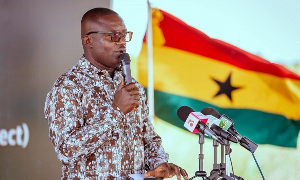
Government’s ongoing renegotiations with Independent Power Producers (IPPs) have resulted in savings of approximately $300 million, according to the Minister for Energy and Green Transition, John Abdulai Jinapor
The Minister made this revelation during a working visit to the Volta River Authority (VRA) in Accra on Friday, October 17, as part of his sector-wide engagement aimed at strengthening the country’s energy institutions and improving operational efficiency.
“Based on the numbers I’m seeing, I’m confident that we can save a lot of money. So far, the IPP renegotiation team has achieved savings of about $300 million,”
John Abdulai Jinapor, Minister for Energy and Green Transition
Mr. Jinapor emphasized that the renegotiation process is not only delivering immediate financial relief but also laying the foundation for long-term energy sustainability.
He commended the collaborative approach between the current administration and its predecessors, noting that continuity in reforms is essential for building a resilient energy sector.
“The previous administration did its bit, and we have also come to improve on it. It’s not always about politics, but Ghana first. I don’t care about your political affiliation as you sit here. Let’s work and turn around this sector,” he stated.
Call for Greater Investment in VRA
The Minister also underscored the need for Ghana to increase investments in the VRA, describing it as a strategic move to reduce over-reliance on private power producers.
He revealed that government currently spends about $840 million annually on power purchases from IPPs funds he believes could be redirected to bolster the VRA’s generation capacity and lower electricity costs over time.
“If we had taken a bold decision and escrowed the tariffs we pay to IPPs about $70 million every month we could have built more thermal plants at VRA and sold power at cheaper rates. Sometimes, we all pretend, but that’s the reality,” he remarked.
Addressing Energy Sector Financial Challenges
Mr. Jinapor further noted that the energy sector continues to exert heavy pressure on the national budget, with over GH¢28 billion allocated this year to cover sector shortfalls.
He warned that without reforms, the deficit could reach GH¢35 billion next year, a trend he described as “unsustainable.”
“If we don’t stop it, virtually all the energy sector shortfalls alone will consume the entire budget. That’s why we’re working aggressively to turn the situation around so that the energy sector can eventually wean itself off the national budget,” he added.
Despite the challenges, the Minister expressed optimism that current reforms, efficiency measures, and improved revenue management would soon yield visible results.
“From the revenues we’re generating and the improvements being made, I can see light at the end of the tunnel though there’s still more work to be done,” he concluded.