

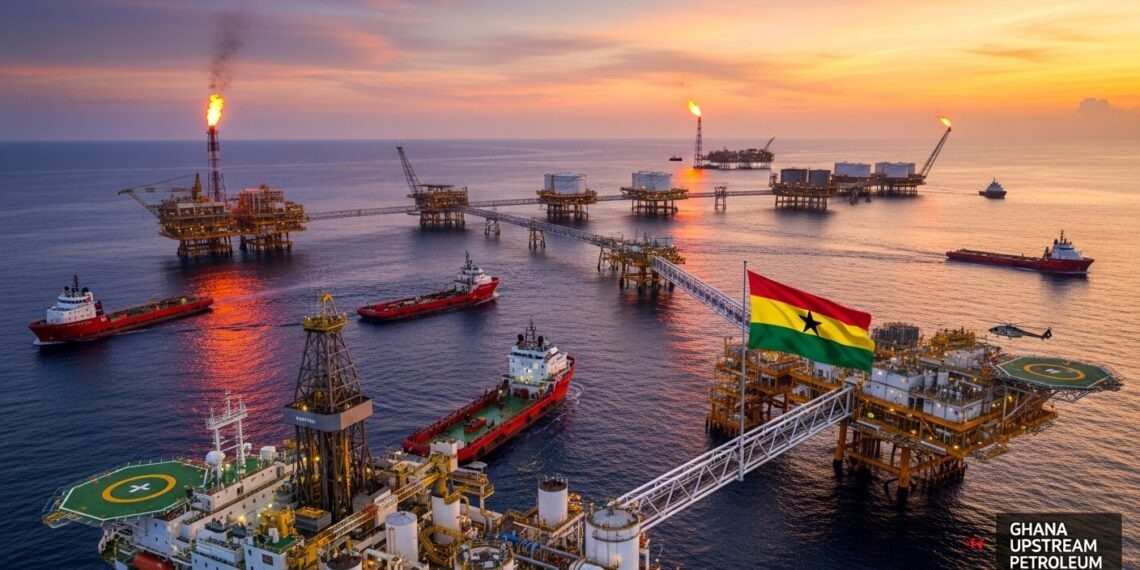
The Ghana petroleum agreements extension has received parliamentary approval, paving the way for continued oil and gas production and fresh investments in the country’s upstream sector.
Parliament ratified the extension of the West Cape Three Points (WCTP), Deepwater Tano (DWT) Petroleum Agreements and the Master Gas Agreement to December 31, 2040.
The decision follows the signing of a Memorandum of Understanding (MoU) between the Government of Ghana, the Ghana National Petroleum Corporation (GNPC), and contractor parties to extend the lifespan of the petroleum agreements beyond their original expiry dates.
Presenting the report of the Committee on Energy to the House, Chairman Hon. Emmanuel Kwasi Bedzrah underscored the importance of the move, stating that “the extension of the agreements will ensure continuity in production and enhance investment in the sector.”
$2 Billion Investment to Sustain Production
Originally scheduled to expire in 2034 for WCTP and 2036 for DWT, the agreements will now run until the end of 2040. Central to the extension is a US$2 billion investment commitment aimed at revitalizing production in mature offshore fields.
The funding will support the drilling of at least 10 and up to 20 new wells, alongside the development of critical subsea infrastructure.
These investments are expected to sustain output from the Jubilee Field and the Tweneboa Enyenra Ntomme Field (TEN), two of Ghana’s major oil-producing assets.
Government officials argue that without proactive measures, natural decline in mature fields could significantly affect national output and revenue.
The new drilling programme and infrastructure upgrades are therefore seen as essential to stabilizing production levels while creating room for further exploration and development.
Government Defends Early Extension
The government has defended the early extension of the agreements as a strategic necessity rather than a premature concession. Officials emphasised that maintaining the current operators and contractual framework will minimise transition risks and prevent disruptions in operations.
According to the justification presented to Parliament, preserving institutional memory and operational continuity is critical in a technically complex industry such as offshore oil and gas production.
Authorities also cautioned that abrupt changes in operatorship or license termination could create uncertainty, delay investments, and undermine energy security.
Despite broad support, the ratification was not without debate. During proceedings, Minority Members of Parliament expressed reservations about approving the extensions years before their expiration dates.
They warned that granting early extensions could set a precedent for other companies operating in Ghana’s petroleum sector to seek similar security.
According to the Minority, the existing timelines provide adequate room for renegotiation closer to expiry, potentially allowing the state to extract more favourable terms.
The Minority further argued that Parliament must remain vigilant to ensure that future negotiations prioritise national interest, transparency, and value maximisation for Ghanaians.
Nonetheless, the majority position prevailed, with the House adopting the Committee’s report and ratifying the agreements.
Master Gas Agreement Brings Pricing and Supply Gains
In addition to the petroleum agreements, Parliament approved the extension of the Master Gas Agreement involving the state, GNPC, and contractor parties. The revised framework is expected to deliver tangible benefits to the domestic energy market.
Under the new terms, gas prices are projected to reduce by 18 percent. Gas supply is also set to increase from 100 million standard cubic feet per day (mmscf/d) to 130 mmscf/d, with the potential for an additional 50 mmscf/d.
This expansion is expected to strengthen feedstock availability for power generation and industrial use.
Furthermore, GNPC’s interest in each petroleum agreement will increase by 10 percent, enhancing the corporation’s stake in the country’s hydrocarbon resources.
The arrangement is also designed to strengthen GNPC’s capacity to gradually assume operatorship roles and deepen institutional expertise within Ghana’s petroleum sector.
Implications for Energy Security and Investment
The ratification signals the government’s commitment to sustaining oil and gas production while positioning Ghana as an attractive destination for long-term energy investment.
At a time when global energy markets remain volatile, policymakers view continuity and investor confidence as critical pillars of national energy security.
The extended agreements provide operational certainty for contractors while giving the state greater leverage through increased participation and improved gas terms.
While debate over timing and precedent continues, the parliamentary decision marks a significant milestone in Ghana’s upstream petroleum governance.
With production continuity assured through 2040, attention will now shift to implementation, oversight, and ensuring that the anticipated economic benefits translate into measurable national development gains.
SOURCE: Vaultz News
Leave a Reply