

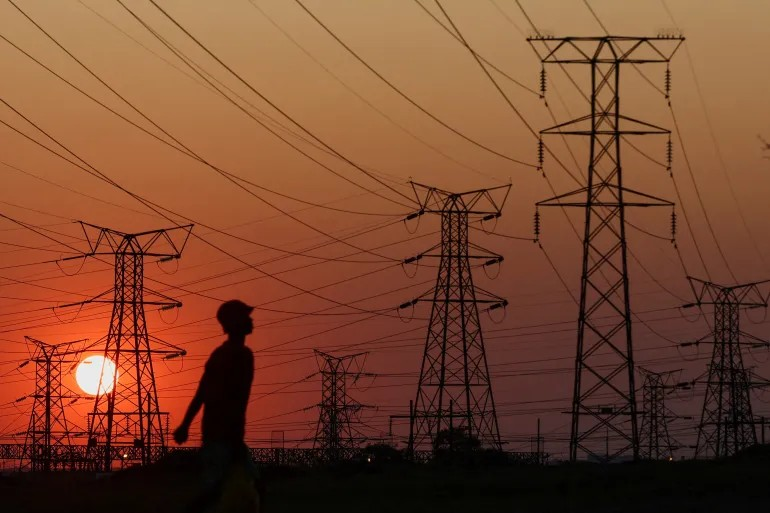
South Africa is far off course on multiple energy milestones, from keeping the lights on today to building the cleaner power system promised for 2030. A review of official targets and real-world delivery shows the country missing by a wide margin on electricity capacity, renewable buildout, and emissions goals even as Eskom rushes out new procurement schemes and grid plans to catch up.
South Africa’s National Development Plan (NDP) envisioned a major expansion of electricity supply by 2030, with 29,000 MW of new capacity, the bulk from renewables. More than a decade later, delivery is well short of the trajectory needed to hit that mark. A recent analysis underscored the gap bluntly: South Africa is “set to miss its energy target by a country mile.”
Compounding the shortfall, Eskom has repeatedly missed its own Energy Availability Factor (EAF) benchmarks set at 60% (2023), 65% (2024), and 70% (2025) leaving less usable power from the existing fleet and prolonging the risk of load-shedding. Current EAF hovers well below target.
Targets vs. reality
Capacity expansion (NDP/IRP): The NDP called for a heavy tilt to renewables, targeting ~20,000 MW of renewables within a 29,000 MW system expansion by 2030. Yet South Africa’s large-scale renewables tally (connected or under construction) was about 15 GW in 2024, implying a steep climb remains and that figure includes projects still being built.
Share of renewables in generation: Independent assessments project only ~20% of electricity from renewables by 2030, below the ambition signaled during the country’s “just energy transition” commitments.
Eskom’s operational recovery: The utility has not reached its staged EAF goals, despite plans to add units back from long outages (Koeberg, Kusile, Medupi) and promises of “big swings” in 2025. The missed EAF milestones are a central driver of ongoing supply insecurity.
Climate commitments: Government officials have acknowledged South Africa will miss its binding 2030 emissions target under the Paris Agreement, in part due to extended lifetimes for coal plants to keep the grid stable while new capacity lags.
Why the shortfall is so large
1) Procurement delays & policy uncertainty. Successive rounds of the Renewable Independent Power Producer Programme (REIPPP) stalled or slowed, while price spikes and supply-chain shocks post-2020 forced re-pricing and cancellations. That has pushed timelines right as demand for new, dispatchable clean capacity rose.
2) Grid bottlenecks. The best wind and solar resources in the Cape provinces are grid-constrained. Transmission buildout has lagged needs, limiting new project connections. Eskom’s Transmission Development planning speaks to the scale of the catch-up required ~14,000 km of new lines and ~37 GW of connection capacity by early 2030s. Until those lines exist, megawatts on paper won’t translate to electrons on the system.
3) Ageing coal fleet performance. High breakdown rates in an old, maintenance-starved fleet keep the EAF depressed. Every missed EAF point forces more diesel speakers, curtailment, and load-shedding and diverts money from investment to emergency operations.
4) Finance and transition friction. International transition finance has been uneven and politically fraught, creating stop-go signals for coal retirements and repowering projects. That uncertainty has slowed the glidepath from coal to renewables and storage.