

StarOil Ghana has adjusted the discounted ex-pump price of its Super petrol at selected outlets from GH¢9.97 to GH¢9.99 per litre, following a revision of the national price floor by the National Petroleum Authority (NPA).
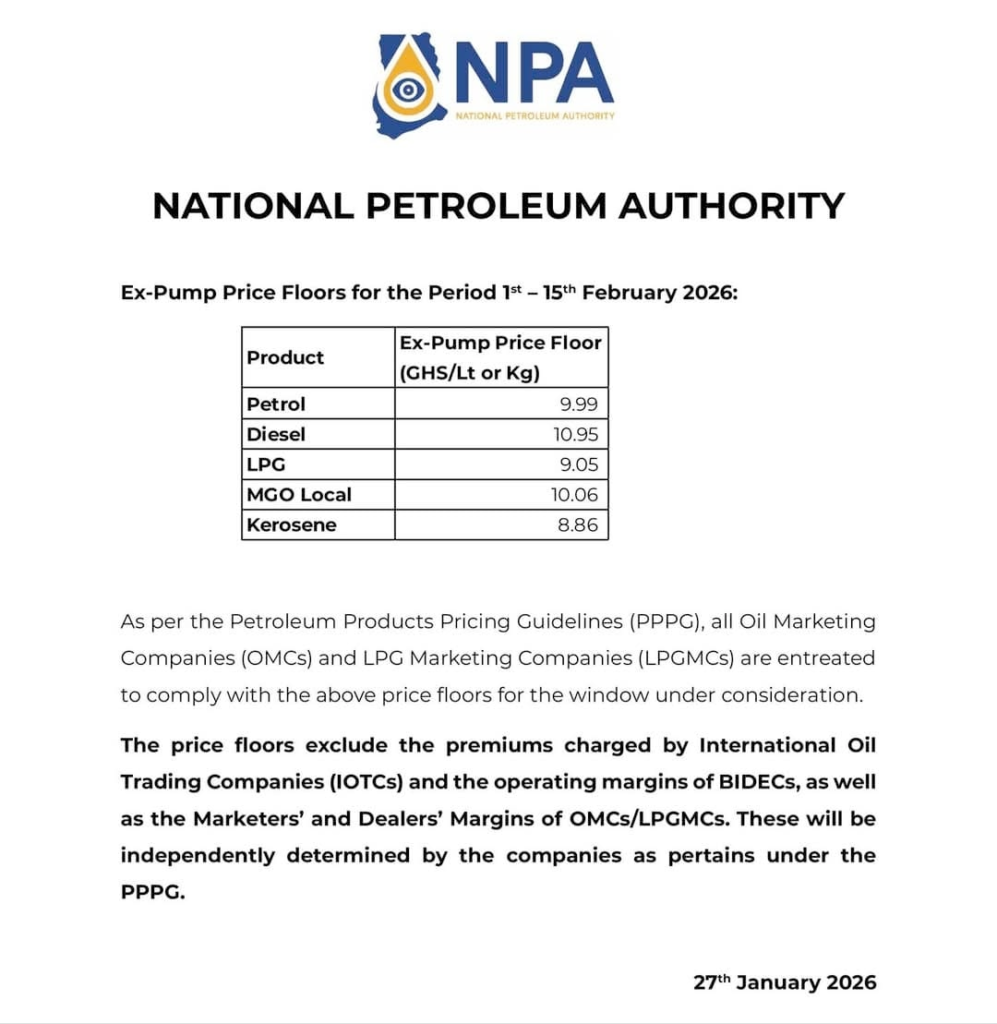
For the current pricing window spanning 1–15 February 2026, the NPA raised the ex-pump price floor for petrol from GH¢9.80 to GH¢9.99 per litre. In compliance with the revised directive, StarOil aligned its discounted Super price with the new minimum threshold.
In the previous pricing window, effective 16 January 2026, StarOil had offered discounted prices of GH¢9.97 for Super and GH¢10.97 for Diesel at selected outlets. At non-discounted outlets, petrol and diesel sold at GH¢10.56 and GH¢11.56 per litre respectively.
Diesel prices have, however, remained unchanged in the current window, as the applicable price floor for diesel stands at GH¢10.95 per litre, below StarOil’s discounted diesel price of GH¢10.97.
Debate Over Price Floors Intensifies
Although the two-pesewa adjustment may appear marginal, it has reignited a broader national debate over the role of price floors in Ghana’s downstream petroleum market.
Proponents of the policy, including the Institute for Energy Security (IES), argue that price floors protect the industry from excessive undercutting and help ensure long-term supply stability. Critics, among them the Chamber of Energy Market Services (CEMSE) and the Africa Centre for Energy Policy (ACEP), contend that the policy weakens competition and limits consumer benefits during periods of favourable global market conditions.
The NPA has also challenged StarOil’s public assertions, noting that the company frequently prices its products above the minimum floor. According to the regulator, this undermines claims that prices would have fallen significantly lower in the absence of a price floor.
Motorists Seek Clarity
As the debate continues, motorists are increasingly asking whether the removal of price floors would have allowed further reductions in fuel prices and provided greater relief at the pump.