

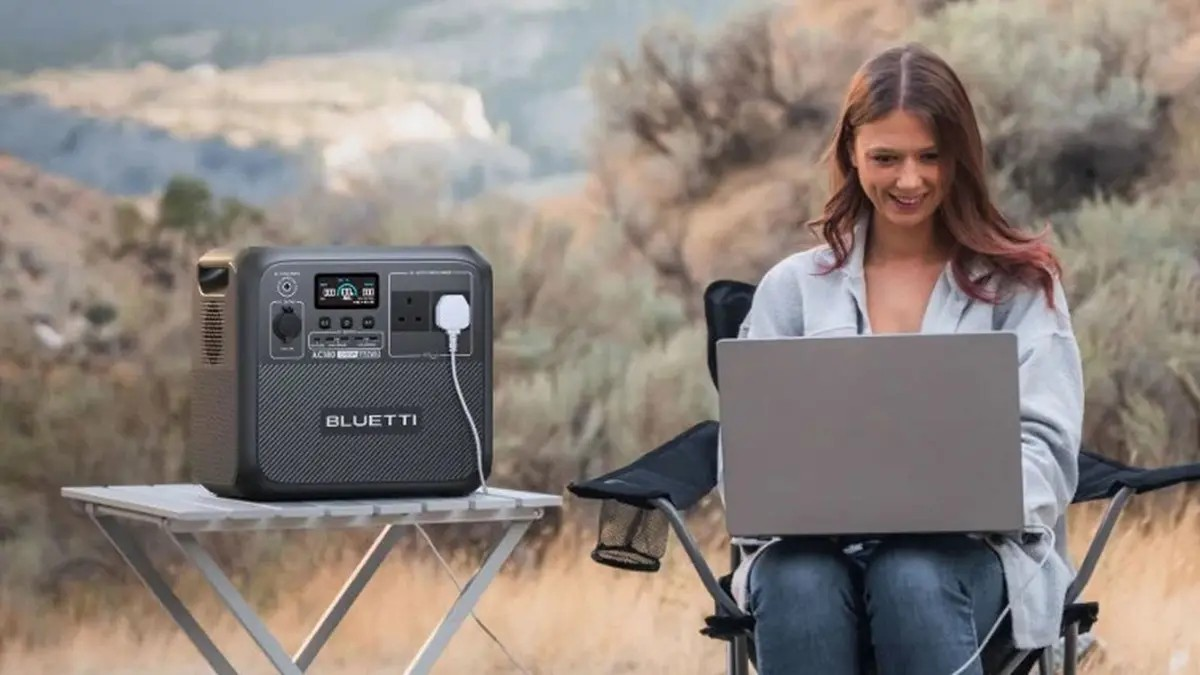
Bluetti unveils the world’s first sodium-ion portable power station, built for extreme cold.
Chinese energy storage and portable power system maker Bluetti has unveiled what it calls the “world’s first” sodium-ion portable power station. Called the Pioneer Na, the system will be available for purchase globally from around mid-October 2025.
First unveiled at the Innovation for All (IFA) conference in Berlin last week, the new system is essentially a large, portable rechargeable battery. Featuring AC and DC outputs, instead of the usual lithium-ion/LFP (lithium iron phosphate) batteries, it uses sodium-ion (Na-ion) batteries.
Bluetti also unveiled some other new products at IFA, including its FridgePower Portable Power Station, a 2,016 Wh, 1,800 W, slim design for appliances. They also unveiled their Apex 300, a 2,764.8 Wh / 3,840 W, expandable to 58,000 Wh (can run a house for days).
Bluetti’s RVSolar 48V System, an expandable to 122 kWh, quick install, for RVs/off-grid homes, also made an appearance.
Portable power for cold climates
According to reports, the Pioneer Na has a 900-watt-hour (Wh) capacity, which is sufficient to power laptops, small appliances, or serve as a backup power source. The system has a standard output of 1,500 watts, with a “Power Lifting” mode for up to 2,250 W (for short bursts or heavy resistive devices like heaters).
The system can be recharged using solar power up to 1,900 W, and has a lifecycle of around 4,000 charge cycles. It is essential to note that the system is approximately 20–25% heavier than its LFP equivalents, with a total weight of 35 pounds (16 kg).
One of the system’s main selling points is its great performance in cold environments. According to reports, it can charge at 5 °F (–15 °C) and discharge at -13 °F (–25 °C).
At the lower end, still delivers 80% discharge capacity (most lithium batteries would shut down or degrade heavily). Even at around 14 °F (–10 °C), it can still recharge to 60% capacity.
To put that into perspective, most LFP batteries usually cannot charge at temperatures below the freezing point. To this end, Bluetti is marketing its new system for cold regions and expeditions (they’re even supplying one to an Antarctic explorer).
Due for release in October 2025
The choice of sodium-ion is a wise one, as sodium is far more abundant and cheaper than lithium. It also performs much better in sub-zero conditions. Battery systems based on it are also potentially safer (less prone to thermal runaway, may handle punctures better).
But, these benefits come with some drawbacks too, such as its relatively lower energy density. This is part of the reason why the system is so bulky and heavy. It is also important to note that it is still new tech, so long-term performance in real-world freeze-thaw cycles isn’t proven yet.
Bluetti’s Pioneer Na is the first real commercial test of sodium-ion batteries in portable power. It’s heavier and slightly less energy-dense than lithium, but it works in deep cold where lithium packs fail, has decent cycle life, and could be safer.
Bluetti is positioning it for households in cold climates and adventurers/explorers as a reliable off-grid backup.