
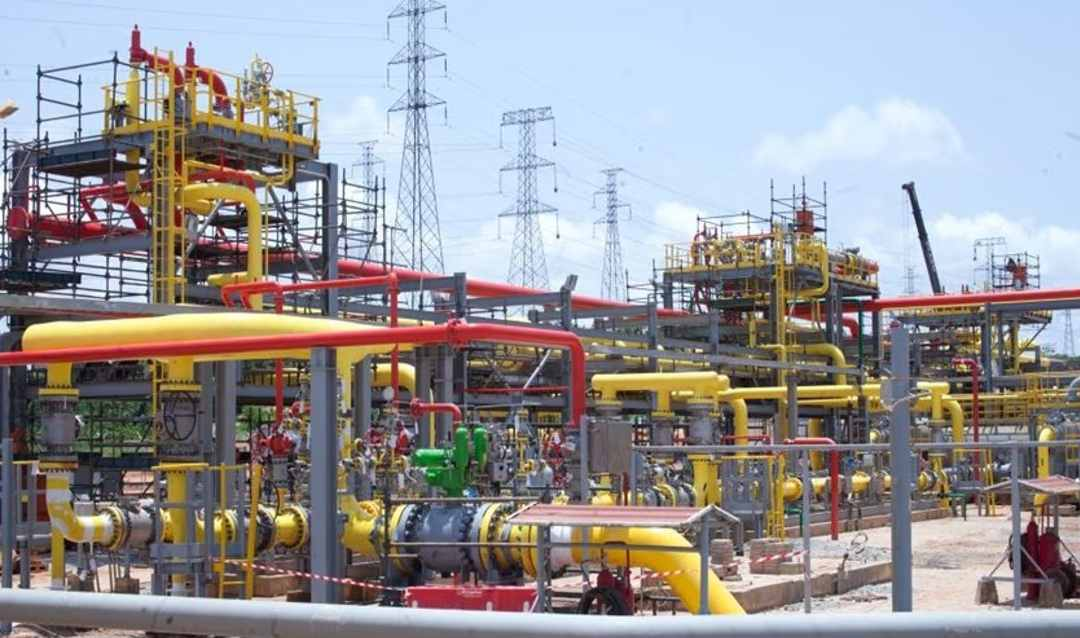
Government’s plan to build a new 1,450-megawatt (MW) thermal power plant is set to place fresh demands on domestic gas supply, with the project requiring an additional 150 million standard cubic feet of gas a day to operate at its planned capacity.
The requirement’s scale raises questions about whether gas from the Sankofa and Jubilee fields can be made available in sufficient volumes, at a competitive cost and with the reliability needed to support the plant, without putting further pressure on supplies to existing power generators and other domestic users.
The proposed expansion comes as government moves to strengthen gas infrastructure through a second gas processing plant, while a recent offshore hydrocarbon discovery has opened a new exploration prospect in the Tano Basin.
Together, these developments offer prospects for improving domestic supply. However, their contribution will depend on the availability of gas from producing fields, timely delivery of infrastructure and further investment in upstream exploration and production.
Presenting the 2027 Budget Statement and Economic Policy to Parliament, Finance Minister Dr. Cassiel Ato Forson said reliable and affordable power remains central to government’s US$10billion, four-year economic programme dubbed ‘The New Economy: New Ghana, Jobs and Prosperity.’
Economic development consulting
He acknowledged that the country’s energy system continues to face high tariffs, distribution losses, weak revenue collection, fuel-supply risks and accumulated financial obligations. In 2025, the energy sector recorded a shortfall of about US$1.4billion while arrears to independent power producers (IPPs) and fuel suppliers stood at approximately US$1.7billion, he said.
Against this background, Dr. Forson announced that construction of the fully state-owned thermal plant at Kafodzidzi-Abrobeano in Central Region will commence in December 2026.
The first 600MW is expected to be ready by December 2028, with the remaining 850MW scheduled for completion by December 2030.
The plant is expected to require an additional 150 million standard cubic feet of gas per day from the Sankofa and Jubilee fields, making availability and reliable delivery of the fuel central to its successful operation.
Government is also pursuing the construction of a second gas processing plant at Anochi in Western Region to expand the country’s capacity for processing domestic gas. President John Dramani Mahama announced at the 2026 Local Content Conference and Exhibition in Takoradi that work has started on the facility, which he said can save the country up to US$1billion annually by reducing reliance on imported liquid fuels for power generation.
However, expanding processing capacity does not necessarily mean more gas will be available. The facility will need sufficient feedstock, while the volumes that can be delivered to power generators will depend on production from existing fields and the development of new resources.
The supply outlook has also received a potential boost from a recent discovery of hydrocarbons at the Nya Gyidie-1X exploratory well in the Deepwater Cape Three Points (DWCTP) Block, offshore Ghana.
The discovery was made by Planet One Oil and Gas Limited and its partners – GOIL Upstream Limited and Ghana National Petroleum Corporation (GNPC). President Mahama announced the find at the 2026 Local Content Conference and Exhibition in Takoradi, describing it as an important milestone for the country’s upstream petroleum sector.
The well marks the country’s first successful test of a carbonate reservoir system, opening a new geological play for further exploration beyond the sandstone reservoirs associated with its existing commercial oil and gas fields.
Located about 148 kilometres offshore Ghana, the well encountered hydrocarbons in carbonate formations. Further technical evaluation and appraisal work will however be required to establish the discovery’s size, characteristics and commercial viability.
It is therefore too early to determine whether, or when, the find can contribute to domestic gas supply. Its immediate significance lies in the prospect it offers for further exploration and the replenishment of Ghana’s petroleum reserves, at a time when production from established fields has been under pressure.
The Technical Director-Public Interest and Accountability Committee (PIAC), Mark Obeng-Adu Agyemang, said the discovery – alongside planned interventions by partners in the Jubilee and TEN fields and Sankofa-Gye Nyame (SGN) project – will be important to sustaining domestic gas supply.
He said the planned work, which includes reservoir management and efforts to remove bottlenecks in non-associated gas systems across the fields, is necessary to improve supply reliability as demand increases.
Beyond the thermal plant, government plans to construct a fully state-owned 600MW solar power facility supported by 2,000 megawatt-hours (MWh) of battery storage.
Dr. Forson said the storage system will shift daytime solar generation to peak-demand periods and support grid stability. Together, the thermal plant, solar facility and battery storage are expected to supply households and industries including bauxite and manganese processing, steel, cement and agro-industry.
Additional gas requirements for the thermal plant however put renewed importance on the country’s ability to sustain production from existing fields, bring new resources into commercial production and expand the infrastructure needed for delivering gas reliably to the domestic market.
Leave a Reply