


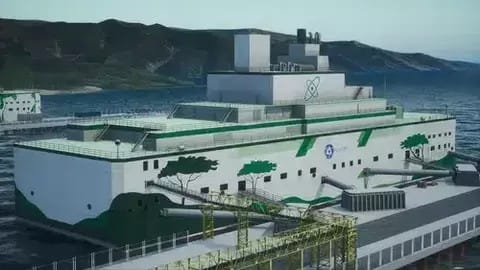
North Maluku is poised to become Indonesia’s first province to receive nuclear-generated electricity under a proposed 200-megawatt floating power project involving Russia’s state-owned nuclear corporation Rosatom.
Rosatom has signed an agreement with Indonesian company Pembangkit Listrik Nuklir to supply 200 megawatts of electricity from floating nuclear power units to North Maluku, in a project aimed at expanding power supplies in eastern Indonesia.
The agreement was signed on the sidelines of Russian Energy Week in Moscow on Friday. The two companies plan to deploy two floating nuclear power units to serve northern Halmahera Island.
The project would use Rosatom’s FPU-100 units, each with a generating capacity of 100 MW and equipped with RITM-series marine reactors. Rosatom said the units could begin supplying electricity to Indonesian consumers within five years after the key terms of the power supply contract take effect.
Rosatom Director General Alexey Likhachev described the agreement as a milestone in energy cooperation between Russia and Indonesia, calling it the world’s first export agreement for electricity supplied by a floating nuclear power unit.
“Cooperation between Rosatom and Indonesia is progressing rapidly. Our recent meeting with President Prabowo Subianto reaffirmed that this world’s largest island nation is consistently pursuing a course toward strengthening energy security and achieving carbon neutrality,” Likhachev said in a statement.
Korea Pitches Nuclear Power Investment for Indonesia.
He said Rosatom was ready to offer advanced, proven technologies, adding that the agreement laid the foundation for a long-term partnership.
“I am convinced that this will send a strong signal to the global business community: with systematic government support, the private sector is actively taking the lead in initiating nuclear infrastructure projects capable of transforming the country’s economy,” he added.
Yudi Utomo Imardjoko, director of Pembangkit Listrik Nuklir and an Indonesian nuclear scientist, said the project was intended to support Indonesia’s energy transition and meet growing electricity demand, particularly in eastern regions.
“Leading Indonesia’s energy transition is our foremost objective and responsibility as a national investor. We firmly believe that providing our people with clean, reliable and carbon-free electricity is essential to securing Indonesia’s long-term energy future,” Yudi said.
He said nuclear power could help meet rising electricity demand while supporting economic development, particularly in eastern Indonesia. He added that the project was structured as a business-to-business (B2B) initiative funded by private-sector investment, without relying on the state budget (APBN).
Indonesia, Singapore Ink MoU on Nuclear Safety
Investor Haji Romo Nitiyudo Wachjo, also known as Haji Robert, welcomed the agreement and thanked Russian President Vladimir Putin, Rosatom and the Russian delegation for their cooperation.
He also expressed appreciation to Indonesian President Prabowo Subianto and Defense Minister Sjafrie Sjamsoeddin for entrusting him and Yudi with the responsibility of advancing the 200 MW project in North Halmahera, North Maluku.
Wachjo, an Indonesian mining entrepreneur of Javanese-Australian descent, is known as the owner of Indotan Group.
Indonesia Explores Nuclear Power
Indonesia has included nuclear power in its national energy planning as part of efforts to strengthen energy security and achieve its target of carbon neutrality by 2060.
Prabowo has discussed cooperation on the peaceful use of nuclear energy with Russian officials, including Putin during a visit to Moscow in July 2024 and Likhachev in May 2026.
The discussions have covered nuclear power development, infrastructure, workforce training and non-energy applications of nuclear technology.
Rosatom on Indonesia’s Nuclear Energy Potential
Rosatom has proposed a two-stage approach to developing nuclear power in Indonesia, beginning with small-scale floating nuclear power units before moving to land-based plants equipped with larger reactors.
The proposed North Maluku project would represent a step toward the first stage of that plan. However, the agreement does not establish whether all necessary regulatory approvals, financing arrangements, and implementation requirements have been finalized.
Floating Nuclear Technology
Rosatom says its FPU-100 units are designed to provide continuous electricity to remote coastal communities and industrial facilities. Each unit would use RITM-200M reactors, which the company says are more compact and offer higher power output than earlier marine reactor designs.
Russia has operated the Akademik Lomonosov, the world’s first floating nuclear power plant, in the Arctic region of Chukotka since 2020. The plant uses two KLT-40S reactors and has generated nearly 1.4 billion kilowatt-hours of electricity, according to Rosatom.
The company is also developing floating nuclear units for industrial customers in Russia and building a small-scale nuclear power plant in Uzbekistan using RITM-200N reactors.
Rosatom says it is constructing 27 nuclear power plants in nine countries, making it a major supplier of nuclear technology to overseas markets.
Leave a Reply