

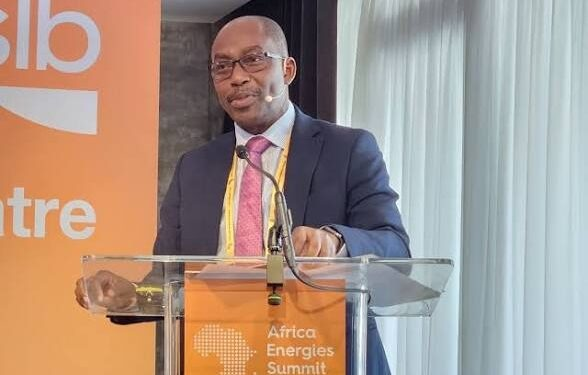
Ghana’s National OilCompany is positioning the Voltaian Basin as the country’s most important long-term upstream frontier, arguing that the underexplored basin could reshape Ghana’s petroleum future at a time when global investment capital is becoming increasingly selective.According to the report, Ghana National Petroleum Corporation (GNPC) Chief Executive Kwame Ntow Amoah said the basin represents a strategic opportunity that extends far beyond the country’s established offshore producing fields.The Voltaian Basin is a strategic frontier covering about 40% of Ghana’s landmass, and it could unlock an entirely new chapter in Ghana’s petroleum story. Ghana National Petroleum Corporation (GNPC) Chief Executive Kwame Ntow Amoah assertedThe statement is one of the clearest indications yet that GNPC is seeking to broaden Ghana’s petroleum narrative from a mature offshore producer into a country pursuing both production sustainability and new frontier growth.Beyond participation: GNPC’s evolving roleAmoah described GNPC’s mandate as extending beyond holding state interests in petroleum agreements.According to the report, the corporation is increasingly focused on building local technical capacity, expanding Ghana’s gas value chain, supporting exploration and preparing for greater operatorship over time.He argued that the National Oil Company now operates simultaneously as a commercial participant and a strategic institution responsible for ensuring that petroleum resources contribute to economic growth, energy security and national development.Today, our role goes beyond participation, with an increasing focus on strengthening local capacity, deepening operatorship, expanding Ghana’s gas value chain and creating the conditions necessary for sustained investment in the sector. Kwame Ntow Amoah statedThis is an important shift in emphasis. The message suggests that GNPC is trying to move gradually from being primarily a state partner in offshore projects toward becoming a stronger operational and technical actor in its own right.Ghana’s mature fields still matter
The interview also reaffirmed the importance of Jubilee, TEN and Sankofa-Gye Nyame, which remain the backbone of Ghana’s petroleum production.Amoah said the experience from these projects demonstrates the value of collaboration between the Government of Ghana, GNPC and international oil companies (IOCs), adding that the corporation views itself as an active partner that seeks to balance investor confidence with national interests.The emphasis on partnership is significant because Ghana is competing for increasingly mobile upstream capital.Many mature basins around the world are offering attractive fiscal terms, lower development risk and established infrastructure.GNPC’s argument is that trust, transparency and alignment of interests remain central to sustaining investment.Frontier exploration becomes the next testThe stronger policy signal, however, is the renewed attention to frontier exploration.Amoah said GNPC and its upstream subsidiary GNPC Explorco are continuing exploration activities in the Voltaian Basin, while also pursuing opportunities linked to marginal field development, infrastructure-led growth and resource clustering around existing facilities.The strategy appears designed to reduce reliance on a single exploration model.Rather than depending only on large new discoveries, Ghana is also looking at ways to create value through infrastructure, efficiency and phased development.Investors are increasingly looking beyond discoveries alone and towards opportunities that can deliver value through innovation, efficiency and collaboration.
GNPC boss Kwame Ntow Amoah assuredThat observation reflects a broader global industry trend in which access to infrastructure, processing capacity and markets can be as important as the discovery itself.Gas moves closer to the centre of policyProjects such as the Offshore Cape Three Points (OCTP) were discussed in the context of project bankability, with Amoah arguing that commercially sustainable arrangements require coordination among government, regulators, investors and off-takers.Gas remains particularly important for Ghana because it supports power generation, industrial activity and broader economic growth.Ghana National Petroleum Corporation (GNPC) Chief Executive Kwame Ntow AmoahThis is arguably the most strategically important part of the interview.Ghana’s future energy security is increasingly tied not only to oil production, but to the ability to produce, transport, aggregate and pay for natural gas reliably.A realistic but ambitious outlookAmoah’s comments suggest that GNPC is pursuing a two-track strategy over the next 12 months.The first track is defensive: arrest production decline and sustain output from existing assets.
The second is offensive: advance exploration in the Voltaian Basin and deepen Ghana’s gas business interests.The interview report places particular emphasis on natural gas.GNPC highlighted its role as Ghana’s National Gas Aggregator and said it is working to strengthen the domestic gas market and improve long-term demand certainty.This dual approach reflects the reality facing many African producers.Existing fields generate the cash flow needed to support the economy, while frontier exploration represents the option value for the future.The challenge is that frontier basins are inherently uncertain and require patient capital.The bigger question: can the Voltaian Basin attract committed capital?The most important issue raised by the interview is not geological potential alone.It is whether Ghana can convert that potential into bankable investment opportunities.The basin’s scale makes it strategically attractive, but investors will ultimately focus on data quality, fiscal terms, regulatory stability, infrastructure access and the commercial path to market.The interview acknowledges this indirectly by repeatedly stressing competitiveness, bankability and alignment across the value chain.What the report reveals about Ghana’s energy directionTaken together, Amoah’s comments point to a broader evolution in Ghana’s energy strategy.
The country is trying to: sustain offshore oil production, expand domestic gas utilisation, strengthen local technical capability, prepare for greater operatorship, and open a new frontier through the Voltaian Basin.The deeper implication is that Ghana is no longer presenting itself simply as a successful offshore oil story.It is attempting to position itself as a more diversified upstream and gas investment destination.Whether that vision succeeds will depend on execution rather than ambition.The Voltaian Basin may indeed become the next chapter of Ghana’s petroleum story, but the transition from frontier promise to commercial reality will require sustained exploration progress, credible regulatory reform, stronger gas-market fundamentals and the ability to convince investors that Ghana can offer both geological opportunity and long-term commercial certainty.The interview was published by Global Business Reports and featured GNPC Chief Executive Kwame Ntow Amoah discussing the corporation’s mandate, Ghana’s upstream investment outlook, the Voltaian Basin, gas development and the company’s strategic priorities