

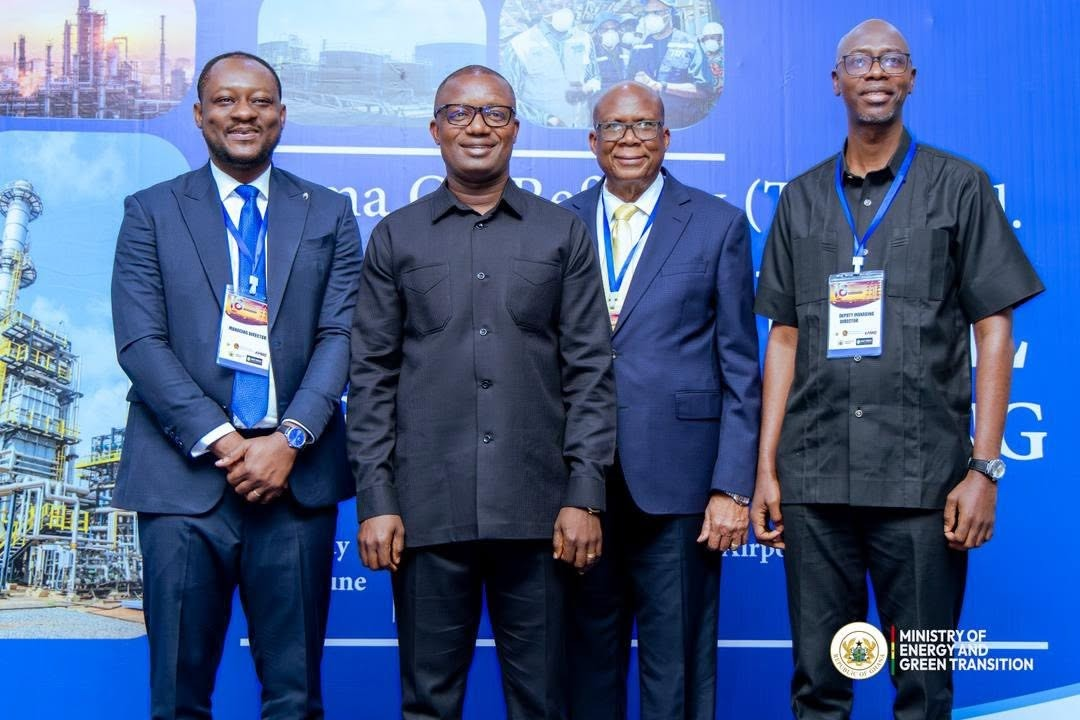
The government has reaffirmed its commitment to the modernisation and recapitalisation of the Tema Oil Refinery (TOR), positioning the state-owned refinery as a critical pillar in Ghana’s long-term energy security strategy.
The assurance was given by the Minister for Energy and Green Transition, Dr. John Abdulai Jinapor, during TOR’s 18th Annual General Meeting (AGM) in Accra, where he highlighted ongoing efforts to strengthen the refinery’s operations, governance systems and financial sustainability.
Dr. Jinapor said the presentation of nine years of audited financial statements covering the 2017 to 2025 financial years marked a major governance milestone for TOR, restoring statutory compliance, improving transparency and rebuilding confidence in the refinery as a strategic national asset.
He also commended the refinery’s improved financial performance and the successful restart of refining operations following maintenance works on its Crude Distillation Unit (CDU), describing the developments as signs of renewed operational progress.
The Minister’s remarks follow TOR’s announcement that the refinery recorded a profit after tax of GH¢1.24 billion for the 2025 financial year, representing its first return to profitability in nearly a decade.
Beyond the financial turnaround, Dr. Jinapor said government’s focus remains on ensuring that TOR becomes a stronger and more resilient institution capable of contributing meaningfully to Ghana’s petroleum sector.
“Government remains committed to supporting TOR’s modernisation, recapitalisation and long-term growth. A strong and resilient national refinery is essential to enhancing Ghana’s energy security, creating jobs, adding value to our crude oil resources and reducing dependence on imported refined petroleum products,” he said.
Strengthening Ghana’s Energy Security
The Minister noted that Ghana’s heavy dependence on imported refined petroleum products exposes the country to global market volatility, foreign exchange pressures and supply disruptions.
He said recent fluctuations in international oil markets, particularly amid geopolitical tensions, have demonstrated the need for Ghana to strengthen domestic refining capacity.
According to him, a revitalised TOR would not only support fuel security but also enhance local value addition by enabling the country to process more of its crude resources domestically.
Broader Energy Sector Reforms
Dr. Jinapor’s comments form part of government’s broader agenda to reposition key energy institutions and improve efficiency across the petroleum, electricity and renewable energy sectors.
Earlier, the Minister led heads of agencies under the Ministry of Energy and Green Transition to the Ministry of Finance, where discussions focused on financing reforms and providing the necessary support to accelerate transformation within the energy sector.
The meeting sought to align policy and financial priorities to strengthen institutional performance and advance Ghana’s long-term energy objectives.
At the AGM, Dr. Jinapor praised TOR’s management for the progress made under Managing Director Edmond Kombat, describing the turnaround efforts as significant.
“Edmond Kombat has demonstrated beyond reasonable doubt that he is capable. Every objective person who takes a critical look at where TOR was, where he has brought the refinery, and where he is taking the refinery, I can only say 100/100,” he stated.
TOR’s Strategic Importance
The Minister emphasised that TOR’s recovery goes beyond corporate performance, noting that the refinery’s sustainability has wider implications for Ghana’s economy.
A stronger TOR, he said, could reduce the country’s vulnerability to external supply shocks, improve fuel supply resilience, create specialised technical employment opportunities and retain more economic value within Ghana.
Industry stakeholders have also noted that strengthening domestic refining capacity aligns with broader efforts across Africa to increase local processing and reduce reliance on imported petroleum products.
The Road Ahead
Despite the refinery’s recent gains, experts caution that profitability alone will not guarantee long-term success.
They say sustained investment, operational efficiency, strong corporate governance and successful recapitalisation will be critical to modernising TOR’s ageing infrastructure and securing its future.
Government’s renewed commitment to TOR’s transformation signals that the refinery will continue to be treated as a strategic national asset, with its recovery expected to support Ghana’s broader energy resilience agenda.
With consistent investment and policy backing, the refinery’s recent turnaround could mark a new chapter in rebuilding Ghana’s domestic refining capacity and strengthening energy security in an increasingly unpredictable global market.