
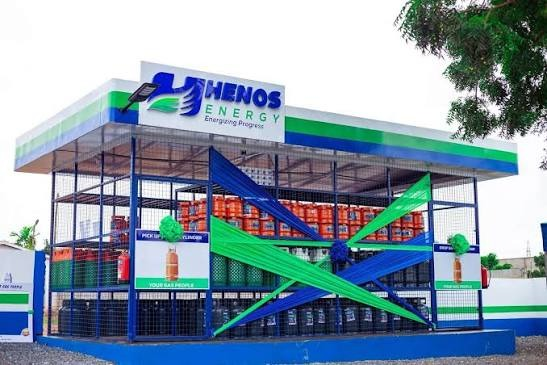
Henos Energy has commissioned Ghana’s first Drive-Thru Cylinder Distribution Outlet (CDO) at East Legon Hills, introducing a new approach to LPG distribution that could change how urban consumers access cooking gas.
The facility operates under the National Petroleum Authority’s (NPA) Cylinder Recirculation Model (CRM), allowing motorists to exchange empty cylinders for filled ones without leaving their vehicles.The model is designed to reduce waiting times while improving the convenience of obtaining LPG.More importantly, the development comes at the intersection of two major energy priorities: expanding access to LPG and building an economy capable of operating beyond conventional working hours.The facility therefore represents more than a new retail outlet.It provides an early example of how Ghana’s LPG distribution infrastructure could evolve towards faster, more consumer-oriented services as demand for convenient energy access grows.“Henos Energy has emerged as a pacesetter in the implementation of the Cylinder Recirculation Model”.
Director of Gas at the NPA, Akua Ntiwaa Kwakye statedThe Director of Gas at the NPA, Akua Ntiwaa Kwakye, made the remarks at the commissioning, praising the company for its role in implementing the CRM.LPG Distribution Moves Towards ConvenienceGhana’s transition towards modern cooking fuels depends not only on the availability of LPG but also on how easily consumers can obtain it.Traditional LPG retailing can involve customers waiting while cylinders are processed or filled.The CRM changes that process by separating cylinder filling from the point at which consumers exchange their cylinders.The drive-through model takes the concept further by introducing convenience into the final stage of distribution.Customers can enter the facility, exchange an empty cylinder for a filled one and continue their journey, potentially making LPG collection significantly quicker.The Head of Gas and Commercial Regulation at the NPA, Obed Kraine Boachie, described the facility as a timely innovation that would make cylinder exchange more convenient for consumers.
The Drive-Thru CDO is a timely innovation that will make LPG cylinder exchange more convenient for consumers. Head of Gas and Commercial Regulation at the NPA, Obed Kraine Boachie saidThe model could become particularly relevant in densely populated urban areas, where time, traffic and accessibility increasingly influence consumer behaviour.A New Dimension to the 24-Hour EconomyThe development also gives practical meaning to the energy component of Ghana’s 24-hour economy agenda.A 24-hour economy requires more than businesses remaining open at night.It requires supporting infrastructure, including transportation, electricity, fuel and cooking energy, to remain responsive to activity outside traditional operating periods.LPG distribution is part of that infrastructure.For households, food vendors, restaurants and other businesses operating during extended hours, access to cooking fuel can directly affect their ability to remain productive.
The significance of the Henos facility therefore lies partly in its demonstration of how energy retailing can adapt to changing patterns of economic activity.If similar models are deployed in other high-demand locations, LPG distribution could increasingly resemble modern fuel retailing, where speed, accessibility and extended operating hours form part of the consumer proposition.Safety Remains Central to ExpansionConvenience, however, cannot come at the expense of safety.
The wider adoption of the CRM has been driven partly by efforts to improve LPG handling and reduce risks associated with the traditional model of customers taking cylinders to filling points for refilling.As the drive-through concept expands, strict adherence to NPA requirements around cylinder handling, storage, transportation, facility design and emergency response will remain essential.This is particularly important as LPG use expands in urban environments, where higher population density increases the consequences of poor safety practices.The NPA’s involvement in the commissioning is therefore significant because the success of the model will depend on maintaining the regulatory standards that underpin the CRM.Could Drive-Through LPG Become the Next Urban Model?The immediate impact of one facility will naturally be limited.
The larger energy question is whether the concept can be replicated commercially and safely across Ghana.That will depend on consumer demand, location, operating costs, cylinder availability and the ability of distributors to maintain sufficient stocks of filled cylinders.There is also a broader infrastructure question.As Ghana seeks to increase LPG penetration, distribution networks will need to become more extensive and responsive rather than simply increasing the number of conventional outlets.From an energy-sector perspective, the East Legon Hills facility is therefore significant because it tests a new way of thinking about LPG distribution.
The drive-through itself is not the transformation.The more important development is the movement towards treating LPG access as part of modern urban energy infrastructure, where safety, speed, accessibility and operating hours become as important as the fuel being sold.If the model proves successful and is replicated beyond East Legon Hills, it could help make LPG more convenient for consumers while supporting Ghana’s broader clean-cooking and 24-hour economy objectives.