

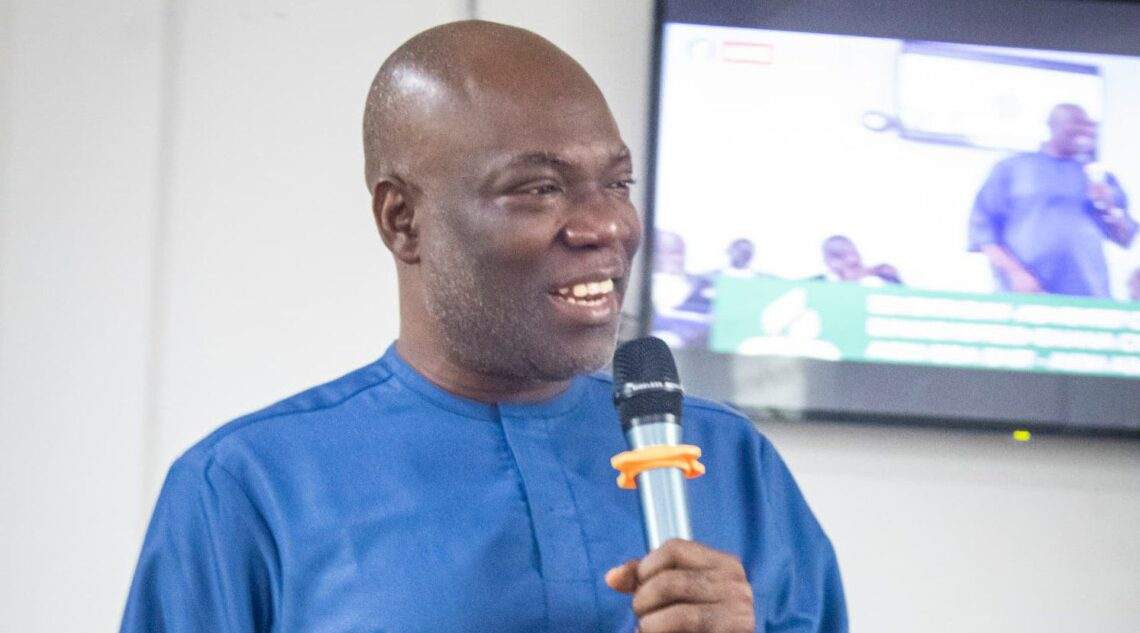
Hon. George Kwame Aboagye
Hon. George Kwame Aboagye, the Ranking Member on the Parliamentary Select Committee on Energy, has clarified that the recent relief in fuel prices at the pump is a result of voluntary margin reductions by Oil Marketing Companies (OMCs) rather than a direct tax cut by the government.
Amidst public outcry over the high cost of fuel, Hon. Aboagye emphasized that the government has declined requests to reduce the heavy tax burden which accounts for over 40% of the price build-up maintaining that state-imposed levies remain unchanged.
“So we want the government to reduce some of the taxes. But the government declined to do it. No, the government hasn’t reduced any tax. It’s rather the oil marketing companies.” Hon. George Kwame Aboagye stated.
This clarification corrects the narrative surrounding recent fuel price adjustments, which some have misattributed to a government-led tax reduction strategy.
According to the Ranking Member, while consumers may be experiencing temporary relief, this is being absorbed by the operational margins of the OMCs, such as the Primary Distribution Margin (PDM) and Fuel Marking Margin (FMM), rather than any fiscal intervention by the state.
While some suggest that state-owned entities like the National Petroleum Authority (NPA) and the Bulk Oil Storage and Transportation (BOST) company are foregoing some margins, Hon. Aboagye insists that these internal adjustments do not constitute a broad, policy-driven reduction of the taxes that the minority caucus has consistently advocated for to ease the economic burden on Ghanaians.
The Case for Tax Relief in the Petroleum Sector
The necessity for government intervention through tax reduction stems from the sheer weight of the current price build-up, where taxes and levies constitute over 40% of the final pump price.
Energy analysts and minority lawmakers argue that in a volatile international market, these fixed statutory levies act as a persistent multiplier of cost.
By maintaining these taxes at high levels, the government effectively keeps the cost of transport, food, and basic goods unnecessarily high, stifling the average Ghanaian’s disposable income.
Reducing these taxes would not only provide immediate relief to motorists but would also ripple through the economy, curbing inflationary pressures caused by the high cost of haulage and logistics.
Deregulation and the Role of Margins
While the downstream petroleum sector operates under a “deregulated” market framework established in 2015, the reality remains complex.
The National Petroleum Authority (NPA) continues to play a significant role, notably through the enforcement of a “price floor” mechanism designed to protect the market from predatory pricing and ensure supply stability.
This creates a scenario where, despite the market-driven nature of the sector, the state remains a central architect of pricing outcomes.
Consequently, when OMCs sacrifice their margins to lower prices, they are often navigating a rigid system where the government’s portion of the price build-up remains essentially untouchable, leaving private operators to bear the financial brunt of price smoothing for the consumer.
Financial Sustainability of Market Players
The current situation places OMCs in a precarious financial position. By pre-financing the shortfalls resulting from reduced margins sometimes waiting months for reimbursement these companies face immense liquidity challenges.
If the government continues to rely on private entities to absorb costs that should technically be addressed through fiscal policy, the long-term stability of the sector is at risk.
Industry stakeholders warn that without a meaningful review of the statutory taxes, the private sector’s ability to maintain high service standards, invest in distribution infrastructure, and ensure a reliable supply of fuel to every corner of the country may be severely compromised.
Leave a Reply