

Namibia must move swiftly from oil discoveries to responsible development and ensure that petroleum resources translate into jobs, business opportunities, skills and sustainable national wealth, President Dr. Netumbo Nandi-Ndaitwah has said.
The President said the country’s emerging oil and gas industry must become a catalyst for economic transformation, industrialisation and enterprise development rather than operate as an enclave disconnected from the wider economy.
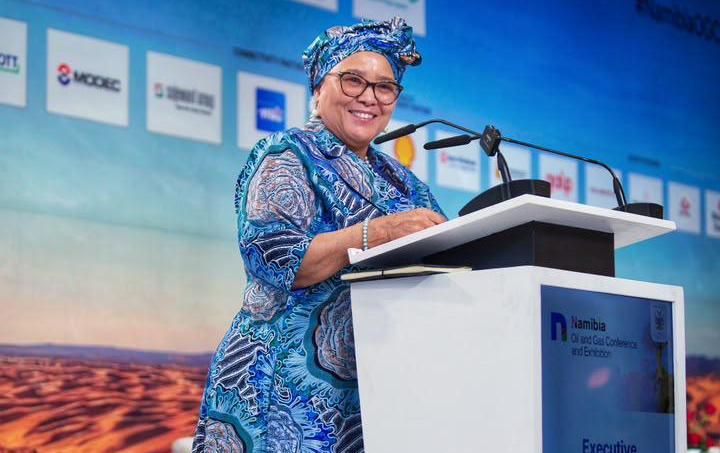
She made the remarks in a statement delivered on her behalf at the opening of the Namibia Oil and Gas Conference 2026 held under the theme, “From Decision to Dividend: Making Namibia’s Oil Work for Namibians.”
The President was unable to attend the conference due to other national duties.
She said recent discoveries in the Orange Basin, including Venus and Mopane, had significantly changed Namibia’s energy profile and attracted major international energy companies and investors.
“Discovery is not the destination,” she stressed, noting that petroleum resources would only constitute a national success when they were responsibly developed and translated into tangible improvements in the lives of Namibians.
According to her, oil wealth must generate employment, opportunities for local businesses, skills for young people, technology for national institutions, infrastructure, government revenues and savings for future generations.
She said decisions being taken on field development, procurement, infrastructure, financing, technology, taxation, environmental management and partnerships would determine how much petroleum value Namibia could retain within its economy.
Preparing for production
President Nandi-Ndaitwah said Namibia must now prepare adequately for the transition from exploration to development and production by strengthening institutions, improving regulatory certainty, developing infrastructure and logistics, building a competitive domestic supplier base and preparing the workforce.
She said government was committed to attracting international capital, technology and expertise needed to develop the country’s complex deepwater resources, but stressed that investors must also contribute to lasting industrial, commercial and human-capital development.
“Government must be predictable in its rules and decisions, while investors must be predictable in their commitments, performance and conduct,” she said.
She identified the Venus discovery as the most advanced offshore development project in Namibia, with publicly announced plans envisaging an FPSO-based development and production of about 150,000 barrels of oil equivalent per day.
First oil has been projected for around 2030, subject to final investment approval and the completion of regulatory, fiscal, environmental and other processes.
The President said Mopane was also progressing, with further exploration and appraisal activities expected to help establish its resource base and development concept.
She, however, cautioned that the urgency to develop the resources must not compromise sound governance, fiscal returns, environmental protection or Namibia’s long-term national interests.
Local content critical
President Nandi-Ndaitwah said petroleum development must create opportunities across the wider economy, including ports, logistics, fabrication, engineering, marine services, financial services, information technology, environmental services, hospitality, training, research and manufacturing.
She said the government had advanced the National Upstream Petroleum Local Content Policy to ensure meaningful participation by Namibians in the emerging industry.
The policy, she said, was designed to build local capabilities, maximise employment, increase participation by domestic suppliers, facilitate technology and knowledge transfer, and promote Namibian ownership and financing across the petroleum value chain.
She urged oil companies and contractors to treat local content as a strategic business responsibility rather than a compliance requirement.
“Early identification of procurement opportunities, transparent contracting processes, meaningful training programmes, technology transfer, mentorship, secondments and supplier development must become part of project planning from the outset,” she said.
She also challenged Namibian businesses and professionals to prepare themselves to compete by investing in quality, certification, financial discipline, project management, health and safety, environmental performance and technical expertise.
Petroleum revenues
The President further stressed the importance of prudent and transparent management of petroleum revenues.
She pointed to the Welwitschia Sovereign Wealth Fund as an important part of Namibia’s institutional framework for preserving resource wealth and strengthening national resilience.
“Petroleum revenue must not be treated as an invitation to consume more today at the expense of tomorrow,” she said, advocating the use of resource revenues to strengthen public finances, support productive investment and preserve wealth for future generations.
She also expressed the government’s ambition to position Namibia as a regional energy and services hub, citing the country’s Atlantic location, port infrastructure, political stability and growing energy investment pipeline as key advantages.
This, she said, would require investment in ports, logistics, marine services, storage, fabrication, training and specialised industrial infrastructure.
Growing interest
The President welcomed the growing international interest in Namibia’s oil and gas sector, saying the conference had attracted more than 1,500 delegates and over 70 exhibitors, compared with 885 delegates two years earlier.
She said the real measure of the conference, however, would not be attendance but the partnerships, investments, business opportunities and policy outcomes that emerge after the event.
“Our ambition is not simply to become an oil-producing country,” President Nandi-Ndaitwah said. “Our ambition is to become a country that uses the petroleum opportunity intelligently to accelerate economic transformation.”
She said Namibia wanted an industry that would leave behind skills, companies, infrastructure, institutions, technology and financial assets for future generations.
The President subsequently declared the Namibia Oil and Gas Conference 2026 officially opened and called on government, industry, investors, financiers, businesses, academia and civil society to work together to ensure that the country’s petroleum resources delivered lasting national benefits.