


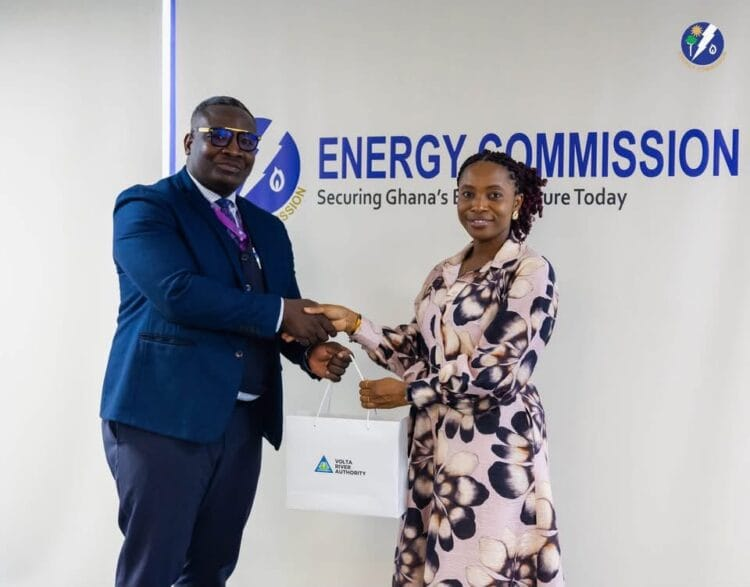
The Energy Commission and the Volta River Authority (VRA) are considering a joint approach to strengthening the capacity of professionals responsible for communicating developments across Ghana’s energy sector.
The discussions emerged from a courtesy engagement between the Commission’s Public Affairs Unit and the Corporate Communications and Branding Section of VRA’s Corporate Affairs and External Relations Department, where both institutions identified opportunities for closer collaboration in strategic communication.
At the centre of the engagement was the possibility of developing joint media training and other capacity-building programmes to improve the ability of energy-sector communicators to explain complex industry issues to the public, businesses and other stakeholders.
Communication Becoming Critical To Energy Governance
The discussions come against the backdrop of an energy sector in which public understanding can directly influence how policies, investments and operational decisions are received.
Issues such as electricity tariffs, renewable energy, power supply, energy efficiency and emerging technologies can involve technical and regulatory considerations that are not always easily understood outside the industry.
For institutions such as the Energy Commission and VRA, effective communication is therefore not simply about publicising activities.
It also involves translating technical information into clear messages that allow consumers, businesses and other stakeholders to understand how developments within the sector affect them.
The Acting Executive Secretary of the Energy Commission, Ms Adwoa Serwaa Bondzie, engaged the visiting VRA team on approaches to communicating effectively with the public, industry participants and other stakeholders.
The discussions also examined how the two institutions can strengthen strategic public communication and improve engagement around the work of the energy sector.
Ghana’s energy architecture involves multiple institutions with different mandates, ranging from regulation and electricity generation to transmission, distribution and policy formulation. Their activities can often intersect on issues that attract significant public attention.
When information from different institutions is unclear or inconsistent, it can make already complicated energy issues more difficult for the public to understand.
The Energy Commission and VRA consequently see closer cooperation among communications teams as a way of improving the consistency and clarity of information reaching stakeholders.
Both institutions exchanged views on strategic communication and stakeholder engagement, with the discussions highlighting the importance of presenting the work of the energy sector in a manner that is understandable and responsive to public concerns.
For energy-sector communicators, this requires more than traditional media relations.
It increasingly involves understanding the technical substance behind policies and projects, anticipating stakeholder concerns and communicating information quickly and accurately when developments have implications for consumers or industry.
Training Could Build A More Informed Energy Communication Network
The proposed media training could also address a wider capacity gap within the energy sector.
As Ghana’s energy system evolves, communications professionals are increasingly required to explain emerging areas such as renewable energy, electric mobility, energy efficiency and other changes affecting the electricity and petroleum industries.
A joint training programme could allow professionals from participating institutions to develop common approaches to communicating these issues while learning from one another’s institutional experience.
That would potentially strengthen the quality of information available to journalists and the wider public, particularly on issues where technical language can create barriers to understanding.
The two institutions have therefore agreed to explore further partnership opportunities in the coming months, although the engagement does not establish a specific training programme or implementation timeline.
Stronger Institutional Cooperation Could Support Energy Transparency
The significance of the discussions extends beyond the two institutions.
Energy-sector communication plays an important role in public accountability because decisions within the sector can affect electricity users, businesses, investors and government finances.
Clear communication can help explain why decisions are being taken, what their expected consequences are and what responsibilities different stakeholders have.
For VRA, whose operations are closely connected to Ghana’s electricity supply system, and the Energy Commission, which plays a regulatory and policy-support role, effective communication is particularly important when sector developments involve multiple institutions.
A coordinated communications approach could consequently reduce information gaps while improving stakeholder engagement.
“Both institutions agreed to explore further partnership opportunities in the coming months.”
The proposed collaboration ultimately reflects a broader recognition that Ghana’s energy transition requires not only technical infrastructure and investment, but also institutions capable of communicating effectively with the people and businesses affected by changes in the sector.
If developed into a sustained capacity-building programme, the partnership between the Energy Commission and VRA could help create a stronger network of energy communicators equipped to explain an increasingly complex energy system with greater clarity, consistency and technical understanding.
Leave a Reply