
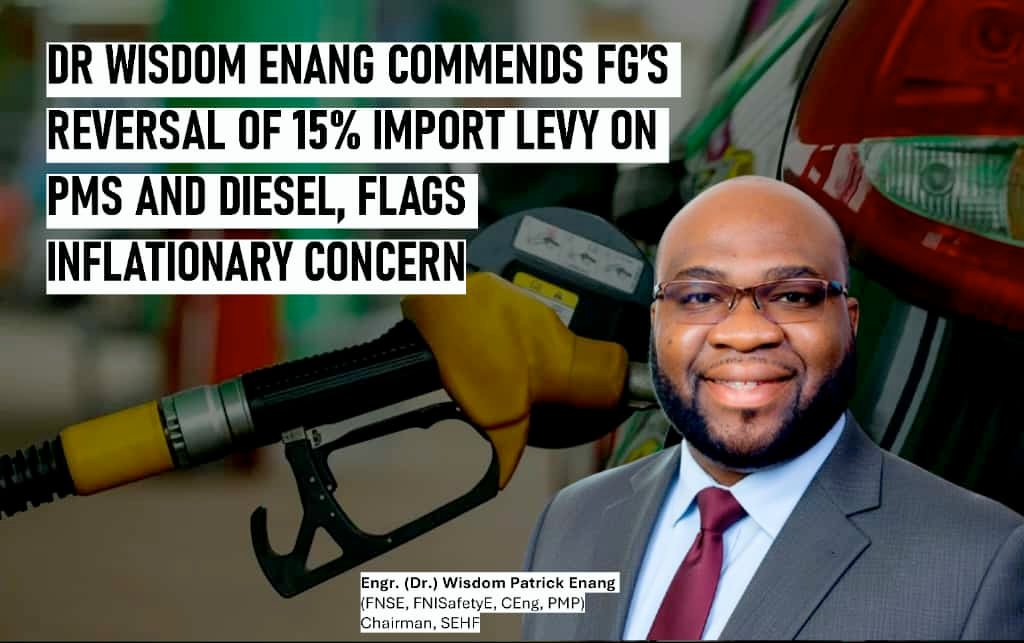
Oil and gas expert and public policy analyst, Engr. (Dr.) Wisdom Patrick Enang, has commended the Federal Government for reversing the proposed 15% import levy on Premium Motor Spirit (PMS) and Automotive Gas Oil (diesel). The levy, which was briefly approved as part of measures to reshape Nigeria’s petroleum sector, had raised concerns over its potential impact on fuel pricing and inflation.
Speaking to journalists in Uyo on Friday, November 14, Dr. Enang described the decision to reverse the levy as timely and economically prudent. He noted that with Nigeria still heavily reliant on imported petroleum products following the removal of fuel subsidies in May 2023, the introduction of an additional levy would have triggered an immediate and widespread rise in prices.
“Inflation does not just rise; it ripples,” he cautioned. “In a country where transport and energy power the cost of everything—from food items to healthcare—policy timing becomes the most fragile determinant of national stability.”
He explained that although the levy was intended to bolster crude transactions in local currency, strengthen domestic refineries, and stabilize fuel supply chains, its unintended consequences would have been severe. According to him, consumers would have faced steep cost increases, further inflaming already high inflation levels.
Dr. Enang also warned that the policy, if implemented hastily, could have been perceived as favouring large industrial players, including the Dangote Group, while placing additional burdens on ordinary Nigerians. With over 133 million Nigerians classified as multi-dimensionally poor, he said, the impact of the levy would have deepened public hardship and reversed recent progress in moderating inflation.
“A tariff is not just an economic tool; it is a social signal,” he stated. “When misaligned with local realities, it can inflame public sentiment. A nation cannot tax its way out of poverty. We must first stimulate production, empower industries, and protect the vulnerable.”
Addressing questions about the long-term viability of the policy, Dr. Enang emphasized that Nigeria’s refining capacity must first be strengthened before such levies can be sustained. He called for increased fiscal support—tax incentives, machinery duty waivers, affordable financing, and targeted infrastructure investments—to help domestic refineries achieve optimal output.
He also urged the government to prioritize transparent communication and stakeholder engagement, noting that any future reintroduction of the levy would require a phased approach tied to measurable improvements in local fuel production.
According to him, public trust will hinge on clear disclosures about how proceeds from such policies are utilized.
“National trust is built through honest accounting,” he said. “If levy revenues are channeled into social safety nets, agriculture, and transport subsidies, economic discomfort can be transformed into shared prosperity.”