

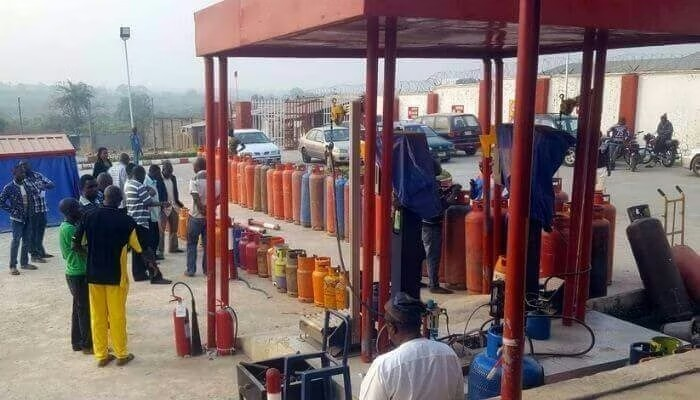
For the fifth month in a row, Nigerian households are feeling the heat, literally and financially, as cooking gas prices climb yet again, leaving many struggling to afford what has become a basic necessity in daily life.
“I used to refill my 12.5kg cylinder for about N15,000 last year. Now, it’s over N21,000,” sighed 38-year-old tailor and mother of three, Blessing Johnson, who lives in Warri, Delta State. “Sometimes I have to stretch it for two months by cooking less often, or I switch to kerosene. But kerosene is also expensive. It’s like we are being squeezed from every side.”
According to the latest report from the National Bureau of Statistics (NBS), the average cost of refilling a 5kg cylinder of Liquefied Petroleum Gas (LPG), popularly called cooking gas, rose by 1.92 percent in June 2025 to ₦8,323.95, up from ₦8,167.43 in May.
While the monthly increase may seem marginal, the year-on-year jump is far more daunting: a 19.49 percent spike from ₦6,966.03 in June 2024.
The bigger cylinders tell an even more painful story. Refilling a 12.5kg cylinder now costs an average of N21,010.56, representing a 1.46 percent rise from May’s ₦20,709.11. Compared to June last year, when the price was N15,736.27, this marks a staggering 33.52 percent increase.
Regional disparities, national frustration
State-by-state breakdown shows significant price disparities. Delta State leads with the highest average refill price for a 5kg cylinder at ₦9,243.38, followed closely by Cross River at ₦9,193.16 and Rivers at ₦9,188.51. For a 12.5kg cylinder, Delta tops the list again at ₦23,108.44, trailed by Cross River and Rivers at ₦22,982.89 and ₦22,971.27, respectively.
On the opposite end, Oyo, Plateau, and Yobe offer some respite for smaller cylinders—averaging ₦7,100, ₦7,200, and ₦7,600, respectively. Yobe also records the lowest 12.5kg refill cost at ₦19,000, followed by Niger (₦19,242.48) and Jigawa (₦20,025.94).
The South-South zone has the highest regional average for refilling a 5kg cylinder at ₦8,871.63, while the South-West pays the least at ₦7,960.42. For 12.5kg cylinders, the South-South again leads with ₦22,179.08, compared to ₦20,402.42 in the South-West.
Read also: Nigeria’s gas waste earns second spot globally
The bigger picture, why prices keep climbing
Nigeria is Africa’s top oil producer, yet the country still imports a large portion of its LPG needs. This heavy reliance on imports exposes local prices to the volatility of the global market.
Disruptions in international supply chains, rising demand from other countries, and geopolitical tensions have all contributed to higher global LPG prices, which trickle down to Nigerian consumers.
Foreign exchange challenges deepen the crisis. The weakening naira means importers spend more to buy dollars for LPG purchases, and these extra costs are inevitably passed to buyers.
“Gas pricing is no longer just a local matter—it’s tied to the global energy market and currency stability,” explained Sola Adeyemi, an energy economist at the University of Lagos. “As long as our domestic production remains insufficient, Nigerians will continue to feel the impact of every fluctuation abroad.”
Disruptions in international supply chains, rising demand from other countries, and geopolitical tensions have all contributed to higher global LPG prices, which trickle down to Nigerian consumers.
Foreign exchange challenges deepen the crisis. The weakening naira means importers spend more to buy dollars for LPG purchases, and these extra costs are inevitably passed to buyers.
“Gas pricing is no longer just a local matter—it’s tied to the global energy market and currency stability,” explained Sola Adeyemi, an energy economist at the University of Lagos. “As long as our domestic production remains insufficient, Nigerians will continue to feel the impact of every fluctuation abroad.”