

Crude oil prices on the global market declined by approximately 2.40% during the 12th to 26th November pricing window. This drop occurred despite stronger demand in China and improved market sentiment following the U.S.–China tariff agreement, as concerns about oversupply from both OPEC and non-OPEC producers continued to weigh on the market. According to the IEA’s November Oil Market Report “Global oil supply was nevertheless up by a massive 6.2 mb/d since January, with gains divided evenly between non-OPEC+ and OPEC+. World oil supply is set to rise by 3.1 mb/d in 2025 and 2.5 mb/d in 2026 on average to reach 108.7 mb/d”.
The refined petroleum product space witnessed international prices rising within the period by about 1.26% and 2.28% respectively for petrol and diesel. The upward trend was largely driven by positive market sentiment following the tariff agreement between the United States and China, improved economic demand in China, and the impact of the U.S. sanctions on Russian crude exports.
We anticipate that global crude oil and refined product prices will maintain a moderately bullish trajectory, supported by steady demand from key Asian markets and persistent geopolitical tensions, particularly the ongoing Russia–Ukraine conflict. Nonetheless, expected increases in supply from both OPEC and non-OPEC producers, along with seasonal demand slowdowns in certain regions, could cap any significant upward movement in prices.
Additionally, we project a slight deceleration in global demand growth for crude and petroleum products in December. This is influenced by the winter season in Europe and North America, as well as the continued rise in electric vehicle (EV) adoption driven predominantly by China. This expanding EV uptake is expected to soften medium-term demand and place downward pressure on global oil prices.
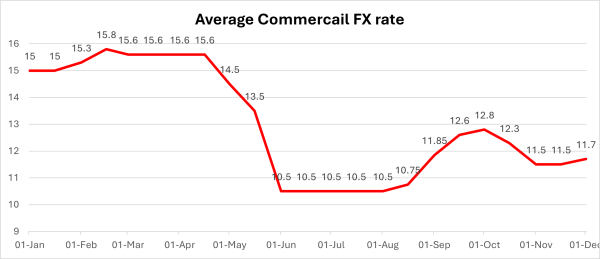
Although the cedi depreciated significantly from September to October, it appreciated considerably against the USD in November, leading to the decline in pump prices experienced in the first window of November. It is expected that the cedi will continue to hold strongly against the USD in December.

OMC Pricing Performance: 16th to 30th November 2025
Pump prices of petroleum products have generally been on the decline since January 2025, although prices rose slightly in June and July due to the abrupt surge in international prices occasioned by the Israel-Iran conflict within the period. The 16th to 30th November pricing window saw a slight rise in the price of Diesel, while LPG declined marginally. The decline was due to the combined effects of international market dynamics and domestic currency performance. This underscores the complex interplay between global events and domestic factors, particularly local currency performance, on the pump prices of petroleum products.

The increase in global crude supply from both OPEC and non-OPEC producers, particularly the United States, Canada, and Brazil, coupled with the appreciation of the Ghana cedi against the US dollar, contributed to a decline in domestic pump prices during the review period.

Average pump prices of diesel increased by an average of 1.29%, with some OMCs selling below GHS12/Ltr and others above GHS13/Ltr. LPG also declined by 2.39% from an average of GHS13.5460/kg to GHS13.1360/kg due to the decline in the international price of LPG.
The rise in international crude and refined product prices, combined with the appreciation of the cedi against the U.S. dollar during the second half of November, resulted in a slight reduction in pump prices of petrol and LPG in the 1st to 15th November 2025 pricing window. However, with the recent uptick in international market prices and the slight depreciation of the cedi within the current pricing window, pump prices are projected to rise in the upcoming window of 1st to 15th December 2025.