


Ghana recorded a sharp fall in oil export earnings in the first ten months of 2025, according to the latest data from the Bank of Ghana, underscoring mounting challenges in the country’s petroleum sector.
By the end of October 2025, oil exports had declined to $2.2 billion, down from $3.3 billion over the same period in 2024, representing a year-on-year drop of about $1.12 billion. The downturn has been driven by a combination of weaker global oil prices and declining domestic output.
Crude oil prices began 2025 trading slightly above $70 per barrel but have since trended downward, falling to lows of around $59 and currently hovering near $60 per barrel. This is well below the $70–$80 range seen throughout much of 2023 and 2024, making 2025 the weakest pricing environment since late 2021. The softer price environment has weighed heavily on oil-exporting economies, including Ghana.
However, analysts note that falling prices explain only part of Ghana’s revenue losses. Declining production has further compounded the situation. After reaching a peak of 71.4 million barrels in 2019, Ghana’s crude output has fallen each year. Production dropped to about 48 million barrels in 2024, while the Public Interest and Accountability Committee projects output of 46.3 million barrels in 2025—a figure that may still prove optimistic.
Earlier ambitions have also fallen short. In 2019, the Ministry of Finance projected oil production of 500,000 barrels per day by 2024. In reality, output in 2025 stands at roughly 126,994 barrels per day, far below that target.
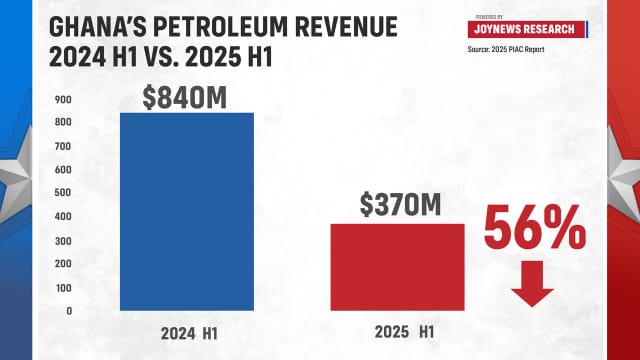
Recent figures highlight the pace of the decline. In the first half of 2025, Ghana produced 18.4 million barrels of oil, compared with 24.8 million barrels during the same period in 2024, a contraction of 25.8 percent. Government revenues from oil fell even more sharply, plunging by 56 percent—from $840 million in the first half of 2024 to $370 million in the corresponding period of 2025.
At the same time, Ghana’s oil import bill has risen. Imports of refined petroleum products increased by about $500 million in the first ten months of 2025 compared with the same period last year. Monthly petroleum imports now average roughly $430 million, up from about $390 million in 2024. The combination of weaker export receipts and higher import costs has intensified pressure on the balance of payments and heightened demand for foreign exchange.
Industry observers attribute these trends to long-standing structural challenges in the petroleum sector. Policy uncertainties in the upstream industry and delays in signing new petroleum agreements have reduced investor appetite, limiting new exploration and development. As a result, declining production continues to erode export revenues and deepen reliance on imported fuel.
Rising domestic demand for refined petroleum products has renewed calls for expanding local refining capacity to reduce imports and ease pressure on the cedi. Petroleum imports, now averaging around $400 million a month, remain a significant drain on foreign exchange reserves.
The Ghana Petroleum Hub Corporation has outlined plans to position the country as a regional refining and trading hub, but progress will depend on consistent policy direction and sustained investment.
Without decisive reforms, analysts warn that Ghana could remain trapped in a cycle of falling production, weaker export earnings and rising import costs. Reviving the sector will require renewed confidence in upstream investments alongside accelerated development of domestic refining capacity. Until then, oil is likely to remain a growing vulnerability rather than a stabilising pillar of the economy.