

Trump administration officials are making a desperate push to secure every available barrel of oil amid a worsening energy crisis — even if it means lifting sanctions on the very country that they’re fighting against.
But three weeks into war with Iran, the administration is running out of options to contain the skyrocketing price of oil and gas.
Trump officials now privately estimate that the higher prices triggered by the war could linger for months, especially as fighting in the Middle East intensifies and passage through the Strait of Hormuz remains nearly impossible, three people familiar with the internal discussions said.
The US has already exhausted all of its go-to policy levers for alleviating the supply shock rippling through the global economy, those people said. The remaining options available to the government range from largely ineffective to deeply unpalatable.
“This is the biggest disruption to the oil markets that you can imagine,” said Neelesh Nerurkar, a former senior Trump Energy Department official. “The shortfall is so large that the measures available are dwarfed by how much oil is not reaching the market.”
The Trump administration has already agreed to release hundreds of millions of barrels from its strategic reserves, eased some sanctions on Russian oil and taken steps domestically to accelerate crude flows throughout the US.
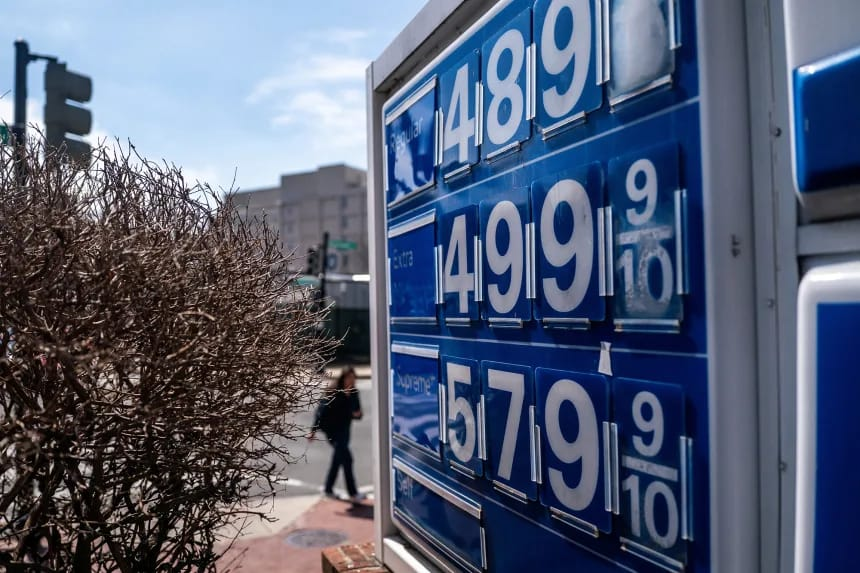
Yet those actions have done little to slow the surge in prices around the world. Brent crude, the global oil benchmark, hit $112 a barrel on Friday — hovering near highs not seen in three-and-a-half years. US gas prices have risen sharply as well, with the national average approaching $4 per gallon.
Officials are now going even further by temporarily removing sanctions on barrels of Iranian oil that are currently at sea, a move that will allow” allies badly in need of supply to purchase them.
The optics of such a move are discomfiting: As the US tries to decimate the Iranian regime militarily, it will simultaneously be allowing the regime to benefit financially. It’s a tacit acknowledgement of the intense economic and political pressure that Iran has put on the US by closing the Strait of Hormuz.
And for President Donald Trump, the dynamics are particularly awkward. After repeatedly criticizing former President Barack Obama for sending cash to Iran as part of his nuclear deal with the country, Trump is now effectively encouraging Iran to step up its oil sales.
But inside an administration trying to manage the widening fallout of the war, the upside of injecting roughly 140 million more barrels into an increasingly parched market was seen as worth it.
Trump officials warmed to the idea in recent days, downplaying the financial significance for Iran of allowing countries to purchase supply that it already has at sea.
That oil would have eventually been purchased by China in spite of US sanctions, they’ve argued. Instead, US allies could buy it, easing their immediate supply concerns at only a slightly higher price than China would have paid Iran otherwise.
“Iran was going to sell those barrels anyway,” said one of the people familiar with the internal discussions. “Instead of going to China, we make it sellable to Thailand or Vietnam.”
Treasury Secretary Scott Bessent on Friday framed the move as “using the Iranian barrels against Tehran to keep the price down as we continue Operation Epic Fury.”
“Iran will have difficulty accessing any revenue generated and the United States will continue to maintain maximum pressure on Iran and its ability to access the international financial system,” he wrote on X.
US Ambassador to the United Nations Mike Waltz said Friday the move to ease sanctions is “very temporary” to “defeat the Iranian strategy of driving energy prices so high.”
“So we’re going to allow it to go in a temporary basis to some of our allies like India, Japan and others so that this strategy from Iran, the Iranian regime, doesn’t work,” Waltz told Dana Bash at a CNN town hall on Iran