

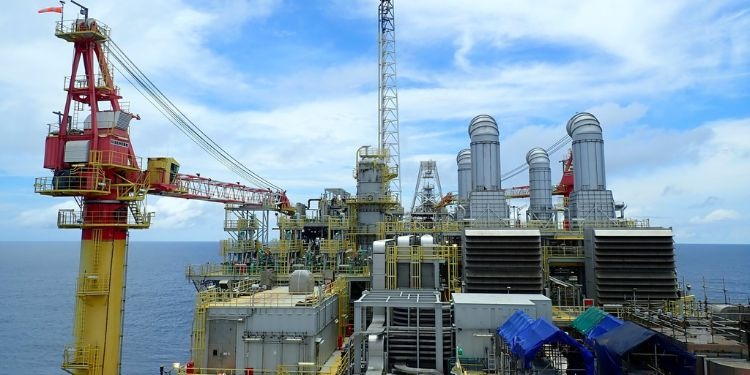
The Nigerian Upstream Petroleum Regulatory Commission (NUPRC) has announced a significant surge in the country’s crude oil output, with production reaching 1.84 million barrels per day (bpd) in March 2026.
This performance marks a robust recovery from the 1.48 million bpd recorded in February 2026, signaling a potential end to the operational volatility that has recently plagued the nation’s energy sector.
“But all that has been fixed, and we are now seeing production ramping up. We are doing 1.84 million barrels per day. That is a remarkable feat, but I am sure we will do more.” Stated the Chief Executive Officer (CEO) of NUPRC, Oritsemeyiwa Eyesan
Nigerian Upstream Petroleum Regulatory Commission (NUPRC) Chief Executive Officer, Oritsemeyiwa Eyesan, disclosed these figures during a strategic visit to the Ministry of Finance headquarters in Abuja, where she briefed the government on the sector’s recovery.
The 24% month-on-month increase was facilitated by the successful resolution of technical disruptions at primary production facilities and the completion of scheduled turnaround maintenance that had previously dampened output.
This rebound is particularly timely as global Brent crude prices have surged by 79.47% year-to-date, climbing from $60.75 to $109.03 per barrel, allowing Nigeria to capitalize on high international demand and improved pricing power.
Strategic Reforms and the “Drill or Drop” Mandate
Beyond immediate production gains, the NUPRC is leveraging the Petroleum Industry Act (PIA) to ensure long-term sector sustainability through aggressive regulatory oversight.
A cornerstone of this strategy is the “drill or drop” clause, which empowers the commission to revoke leases for dormant acreages that have failed to see active exploration.
Eyesan expressed strong optimism regarding the 2025 licensing round, which is currently undergoing technical and financial evaluation, noting that the “drill or drop” provision ensures that only capable, active investors retain control of Nigeria’s hydrocarbon assets.
The commission’s commitment to transparency is further evidenced by its total compliance with Executive Order 9 of 2026.
This directive has fundamentally altered the industry’s fiscal landscape by suspending the 30% Frontier Exploration Fund (FEF) deduction from oil and gas profits.
By redirecting these funds along with various management fees directly into the Federation Account, the government is ensuring more immediate liquidity for national development.
Eyesan noted that “indigenous companies are demonstrating impressive capacity,” suggesting that the next generation of Nigerian oil production will be increasingly driven by local expertise and faster project lifecycles.
Economic Implications and Lessons for the African Continent
This production milestone serves as a critical fiscal lifelines for Nigeria, providing the necessary foreign exchange to stabilize the Naira and fund the N67.4 trillion 2026 budget.
The Nigerian model demonstrates that stagnant assets are a liability to national security.
African nations must learn that rigorous enforcement of development timelines, coupled with the elimination of opaque deduction funds, is the only way to ensure that natural resources benefit the citizenry rather than just the balance sheets of dormant operators.
Leave a Reply