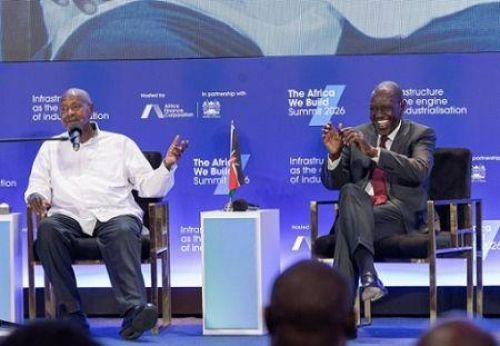
Kenya plans to invest in Uganda’s Hoima refinery. The deal deepens energy ties between the two countries and across East Africa. President William Ruto said on April 23 in Nairobi that Kenya will invest in Uganda’s planned Hoima refinery, framing the move as a reciprocal step after Uganda took a stake in Kenya Pipeline Company (KPC). Speaking at the Africa We Build Summit 2026, Ruto said the partnership reflects a shared effort to develop and manage regional energy resources. “I want to assure you that the same way Uganda sought to invest in Kenya Pipeline, Kenya is going to invest in your refinery and in the future of our resources together,” he said. Ugandan President Yoweri Museveni welcomed the move, describing it as a step toward strengthening local oil processing and regional cooperation. The announcement follows KPC’s recent stock market listing, which raised more than $825 million. Kenyan investors acquired 7.9 billion shares, while regional investors—including Uganda and Rwanda—bought around 3.8 billion. Uganda secured a 20.15% stake in KPC, reinforcing its role in an infrastructure network that handles more than 95% of its fuel imports. Overall, East African Community investors now hold 21.22% of KPC, while the Kenyan government retains 35%. These cross-investments between transport and refining assets suggest a gradual alignment of interests across the region, linking Kenya’s logistics infrastructure with Uganda’s industrial capacity. At the center of Uganda’s strategy is the Hoima refinery, a $4 billion project expected to process 60,000 barrels per day. The facility is designed to produce fuels, kerosene, and petrochemicals, while also incorporating gas processing. Commissioning is planned between late 2029 and early 2030. The refinery forms part of Uganda’s plan to monetize its estimated 6.5 billion barrels of oil reserves as it prepares to become a producer. Authorities aim to meet domestic demand, estimated at 36,000 barrels per day, while supplying regional markets such as Tanzania and the Democratic Republic of Congo. The project could save more than $1.23 billion annually by reducing imports of refined products. The initiative comes against a broader backdrop of limited refining capacity across Africa. The continent produces around 10 million barrels of crude oil per day but still imports close to $90 billion in refined petroleum products each year, limiting value capture and sustaining external dependence. Refining projects are increasingly seen as a way to strengthen industrial capacity and energy sovereignty. But financing has become more complex, as global energy transition commitments weigh on investment in hydrocarbons. In that context, equity financing and regional partnerships—like the one emerging between Kenya and Uganda—are gaining traction. At the same time, Kenya is advancing its own upstream ambitions through the South Lokichar project, where production is expected by December 2026, with an estimated 585 million barrels of recoverable reserves. The success of these efforts will depend on securing crude supply, building reliable export markets, and sustaining investor interest in a sector facing structural shifts.


Leave a Reply