

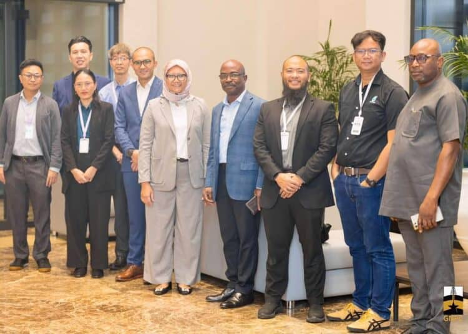
Ghana is stepping up efforts to attract fresh technical expertise and investment into its upstream petroleum sector as the Ghana National Petroleum Corporation (GNPC) begins a two-week technical and commercial engagement with Malaysia’s PETRONAS.
The discussions in Accra bring specialists from both institutions together to examine Ghana’s exploration prospects, discovered petroleum resources and other opportunities across the upstream value chain.
The engagement comes as Ghana’s petroleum industry confronts a difficult production outlook, with mature producing fields experiencing natural decline and the country needing new discoveries, investment and improved recovery to sustain output over the longer term.
Technical Assessment Takes Centre Stage
The meetings, being held at the GNPC Research and Technology Centre, are covering exploration, subsurface and geological studies, engineering, discovered assets, new ventures and commercial development.
GNPC has assembled specialists across geology, geophysics, engineering and commercial development to engage their PETRONAS counterparts.
The format is significant because investment decisions in upstream petroleum increasingly depend on detailed technical and commercial assessments rather than simply the existence of prospective acreage.
For Ghana, the engagement provides an opportunity to place its remaining exploration opportunities, discovered resources and technical data before an international energy company with experience across the petroleum value chain.
Fresh Investment Becomes Increasingly Important
Ghana’s upstream sector needs a stronger investment pipeline as existing fields mature.
The country’s three major producing areas; Jubilee, TEN and Sankofa-Gye Nyame, have been central to national oil production, but declining output from mature assets has increased the importance of new wells, enhanced recovery, exploration and new field development.
That makes the search for new technical and financial partners more urgent.
The PETRONAS engagement could therefore be viewed as part of a broader effort to widen the pool of companies assessing Ghana’s upstream opportunities, rather than as evidence of a concluded investment agreement.
GNPC has not indicated that PETRONAS has committed to a specific block or project through the engagement.
That makes the search for new technical and financial partners more urgent.
The PETRONAS engagement could therefore be viewed as part of a broader effort to widen the pool of companies assessing Ghana’s upstream opportunities, rather than as evidence of a concluded investment agreement.
GNPC has not indicated that PETRONAS has committed to a specific block or project through the engagement.
GNPC Seeks Stronger Technical Partnerships
Welcoming the PETRONAS delegation on behalf of GNPC’s Chief Executive, Deputy Chief Executive for Finance, Commercial and Administration Hamis Ussif expressed the Corporation’s readiness to support the discussions.
GNPC Director of Projects Dr Albert Longdon-Nyewan also emphasised the Corporation’s interest in developing areas of collaboration with the Malaysian energy company.
“We are interested in working collaboratively with PETRONAS to identify opportunities that can support investment and the continued development of Ghana’s petroleum resources.” Dr Albert Longdon-Nyewan, Director of Projects, GNPC stated.
The emphasis on technical engagement is important because Ghana’s next phase of upstream development will require more than capital.
Exploration and development projects require sophisticated subsurface interpretation, reservoir management, drilling expertise, project engineering and commercial structuring.
International partnerships can provide access to some of these capabilities while reducing the technical and financial risks associated with developing complex resources.
The Real Test Is What Follows
The immediate value of the engagement will be determined by what emerges after the technical discussions.
A successful assessment could lead to further due diligence, commercial negotiations, farm-in arrangements, exploration activity or investment in discovered resources. None of those outcomes should, however, be assumed from the commencement of the engagement itself.
For Ghana, attracting companies such as PETRONAS is particularly relevant because the upstream sector is entering a period in which replacing declining production will require a sustained pipeline of investment.
New discoveries would be valuable, but discoveries alone do not guarantee production. Commercial viability, resource size, development costs, infrastructure, fiscal terms and expected returns ultimately determine whether petroleum resources move from geological potential to producing assets.
The two-week engagement consequently represents an early stage in a much larger investment process.
Ghana’s strategic challenge is to convert its remaining upstream potential into commercially viable projects quickly enough to offset declining production, while ensuring that new investment brings technology, skills and greater domestic value capture.
The significance of the GNPC-PETRONAS discussions will therefore lie less in the meetings themselves than in whether technical interest can eventually be converted into exploration, development and sustained production.
Leave a Reply