

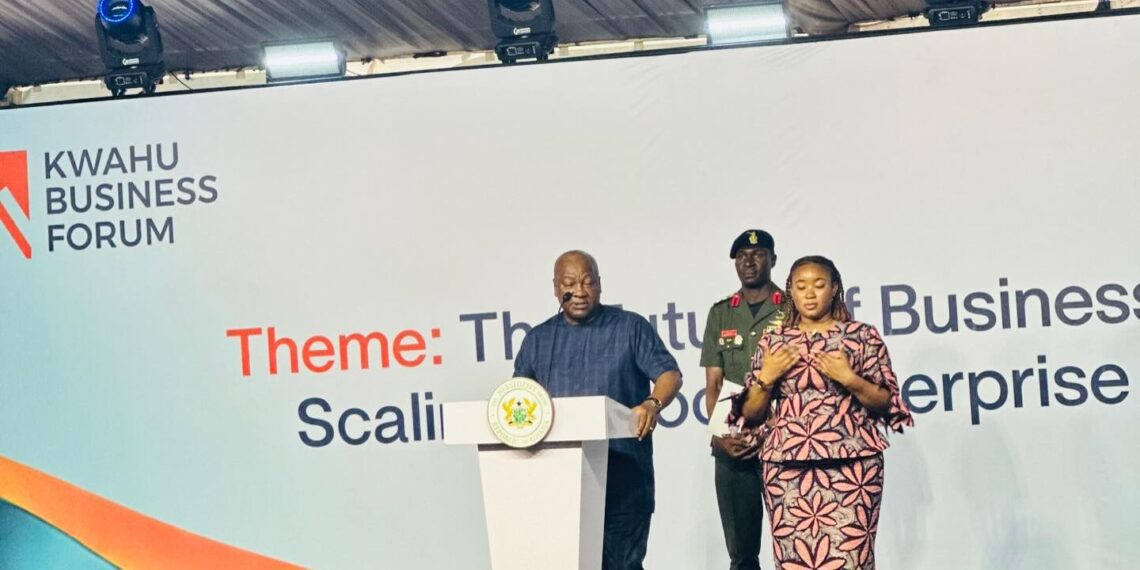
resident John Dramani Mahama has reaffirmed the successful resolution of a staggering $1.7 billion debt overhang within the nation’s power sector, marking a pivotal turning point in Ghana’s quest for energy stability.
Speaking at the 2026 Kwahu Business Forum, the President detailed a comprehensive fiscal cleanup that has effectively neutralized the financial “drag” that the energy sector has long imposed on the Ghanaian economy.
This strategic settlement was achieved through a rigorous negotiation process with Independent Power Producers (IPPs), resulting in a sustainable roadmap that addresses both historical arrears and current consumption obligations.
“And I’m pleased to report to you that we have cleared up a lot of the debts in the power sector. When we came into office, we had a debt overhang of about 1.7 billion dollars, not Cedis owed to the independent power producers.” president Mahama stated.
The President explained that upon assuming office, his administration inherited a massive debt stock of $1.7 billion not in local currency, but in US dollars owed to private power generators. To resolve this, the government engaged the IPPs in a restructuring exercise mirrored after the broader national debt exchange, requiring these partners to accept “haircuts” of approximately 20% on the total amount owed.
In exchange for these concessions, the government provided immediate down payments and established a disciplined schedule for subsequent installments.
Beyond settling these “legacy debts,” Mahama emphasized that the government is now “keeping up with their present-day bills,” ensuring that every month’s electricity consumption is paid for in full and on time to prevent any future accumulation of arrears.
“We sat down with them, we agreed on a roadmap. Since Ghanaians were all taking haircuts from the debt restructuring, we told them they also must take haircuts. And so they agreed on the haircuts.”
President John Dramani Mahama said.
Restoring Fiscal Credibility and Investor Confidence
The settlement of the $1.7 billion debt serves as a critical signal to the international community and private investors that Ghana is reclaiming its fiscal sovereignty.
For years, the power sector was characterized by a “circular debt” crisis, where the inability of the Electricity Company of Ghana (ECG) to collect sufficient revenue led to a default at the top of the value chain. By clearing the $597 million World Bank Partial Risk Guarantee and settling outstanding invoices to upstream gas suppliers like ENI and Vitol, the Mahama administration has effectively “unlocked” the energy sector’s financial bottlenecks.
This cleanup is not merely an accounting exercise; it is a fundamental reset of the energy economy. By moving from a state of constant default to one of “present-day” payment compliance, the government has reduced the risk premium associated with Ghana’s energy projects.
This newfound stability is expected to lower the cost of future power purchase agreements (PPAs), as investors no longer need to price in the high risk of non-payment.
Driving the Green Transition and Industrial Growth
With the legacy debt mountain leveled, the Ministry of Energy and Green Transition is now better positioned to pivot toward sustainable power sources.
The financial “drag” mentioned by the President had previously cannibalized funds that could have been allocated to renewable energy infrastructure.
Now, with a “predictable policy environment,” the government can focus on the “Cash Waterfall Mechanism,” a transparent payment system that ensures revenues collected from consumers are distributed equitably among all players in the value chain.
The relief provided by this settlement extends directly to the Ghanaian manufacturing sector. As the President noted during the forum, “Ghana must produce more of what it consumes,” a goal that is impossible without reliable and affordable power.
By stabilizing the IPPs, the government has ensured a “consistent nationwide electricity generation” that serves as the bedrock for industrialization.
This move effectively ends the era of “uncontrolled energy sector debt accumulation,” allowing the country to focus on value addition and job creation rather than crisis management.
New Era of Transparency and Accountability
The “roadmap” agreed upon with the IPPs includes a 36-month payment period for the remaining restructured debt, a move that provides the state with much-needed fiscal breathing room.
To prevent a recurrence of the crisis, the administration has implemented legal reforms mandating competitive power procurement and the publication of all power contracts.
Industry analysts at the forum noted that the “full and timely disclosure” of these financial obligations is what will ultimately sustain the sector’s health.
By treating the energy sector as a business rather than a political tool, the government is ensuring that the lights stay on not just today, but for the next generation of Ghanaian entrepreneurs.
This strategic settlement, characterized by “discipline over waste,” has already resulted in credit rating upgrades from major global agencies, affirming that Ghana is indeed open for business
Leave a Reply