

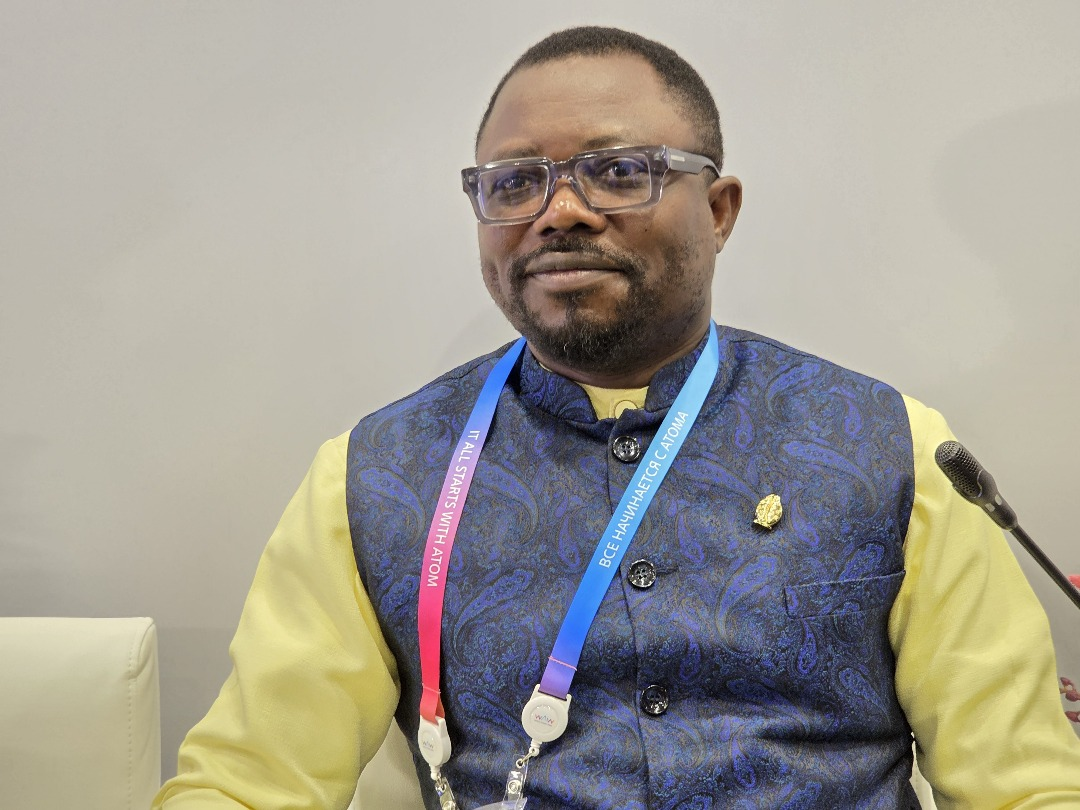
The Deputy Director in charge of Alternative and Nuclear Energy at the Ministry of Energy and Green Transition Dr. Robert Mawuko Sogbadji, has confirmed that Russia is talking to Ghana about the possible deployment of three floating power units of 100MW each to help enhance the country’s power supply base that could be made available within a shorter term. He said floating nuclear plants have become preferable because of its flexibility, movability and expandability. Speaking to Ghanaweb.com at the just-ended World Atomic Week in Moscow, Dr. Sogbadji explained that floating nuclear plants have become increasingly attractive because of their flexibility, mobility, and scalability. Dr. Sogbadzi represented the Deputy Minister of Energy and Green Transition at the just ended World Atomic Week celebration in Moscow Russia.
He noted that the idea of generating power from a vessel would not be entirely new to Ghana, referencing the country’s experience with the Karpowership project.
“We are already producing power from a floating vessel in the form of Karpowership, so this concept is not new to us. With our Nuclear Regulatory Authority and the Environmental Protection Agency in place, coupled with guidance from the International Atomic Energy Agency and Russia’s Rosatom regulator, the process will be well-governed,” Dr. Sogbadji stated.
Short-Term Solution Ahead of Large-Scale Nuclear Power
According to him, FPUs could help bridge potential electricity shortfalls while Ghana advances plans for a larger, land-based nuclear power plant capable of generating over 1,000MW through the proposed establishment of a large-scale Nuclear Power Plant.
He emphasized that floating power units are easier to deploy in the short term, providing a stop-gap solution for the country’s growing power needs.
Funding and Ownership Model
On financing, Dr. Sogbadji stressed the importance of structuring a model that balances affordability with industry needs.
“Because this is nuclear, it cannot be entirely private-sector driven. Government must participate, even if only by 10–15%, but in a way that keeps costs low for both domestic and industrial consumers,” he explained.
‘’ We have to look at the funding mechanism which will make the Ghanaian industry comfortable both domestic and commercial. Government has to be in there in whatever small amount but in a situation which will make it as cheap as possible for industry to obtain power from nuclear power production’’ added Sogbaji
He further clarified that Ghana is not seeking to own the floating units outright, as full ownership could push costs higher. Instead, the government is considering a public-private partnership (PPP) model, focusing on independent power production under strict regulatory oversight.
Grid Capacity Not a Constraint
Addressing concerns about whether Ghana’s grid can absorb nuclear-generated electricity, Dr. Sogbadji dismissed fears of potential transmission challenges.
“GRIDCo’s transmission losses are within internationally accepted limits. Integrating a 100MW baseload from each floating power unit will not be a problem. Even Karpowership delivers 400MW, so handling FPUs will not present difficulties,” he assured.
Nuclear Power as a Reliable Option
Dr. Sogbadji praised nuclear power for its efficiency, reliability, and ability to provide consistent baseload electricity to support Ghana’s industrialization agenda.