

As Ghana steadily advances its national nuclear power programme, China’s pioneering integrated reactor design offers a compelling case study in small modular nuclear technology.
Ghana’s Energy Transition and Nuclear Ambition
Ghana stands at a pivotal juncture in its national energy development. With a rapidly growing economy and an expanding industrial base, long-term national planning requires a secure, reliable, and low-carbon base load electricity source. A central pillar of this vision is Ghana’s deliberate push toward nuclear energy. In 2022, Ghana reached a key milestone by transitioning to Phase 2 of the International Atomic Energy Agency’s (IAEA) Milestones Approach, establishing the foundational institutional, regulatory, and technical infrastructure required for a safe nuclear programme.
Drawing insights from the changing global energy landscape, Ghana is carefully evaluating diverse technological pathways for the nation’s first nuclear plant. While traditional large-scale reactors offer substantial generation capacity, they demand extensive initial grid infrastructure and heavy upfront capital outlays. In response, Small Modular Reactors (SMRs) are emerging as an adaptable alternative, offering scalable generating capacity, enhanced safety profiles, and the flexibility to support industrial applications.
Among global SMR technologies, China National Nuclear Corporation (CNNC) has pioneered the ACP100 (Linglong One), which is the world’s first land-based commercial small modular reactor of its type to pass international safety reviews, providing a relevant reference point for Ghana’s energy planners across developing economies.
ACP100 (Linglong One): A Compact, Integrated Reactor
Developed by CNNC, the ACP100 is a third-generation small modular reactor engineered to deliver approximately 125 megawatts of electricity (MWe). Designed with a 60-year operational life and a planned refueling interval of roughly two years, the reactor combines compact infrastructure with enhanced safety mechanisms.
What sets the ACP100 apart is its integrated reactor design, which builds safety directly into its physical structure. By housing key primary cooling components within a single steel pressure vessel, the reactor eliminates large external primary piping altogether.
Building on this compact architecture, the ACP100 incorporates passive safety systems that rely entirely on fundamental physical principles, including gravity, natural circulation, and ambient air convection, to continuously reject residual core heat. As a result, the plant is designed to automatically maintain continuous cooling for up to 72 hours without requiring active electrical power or operator intervention.
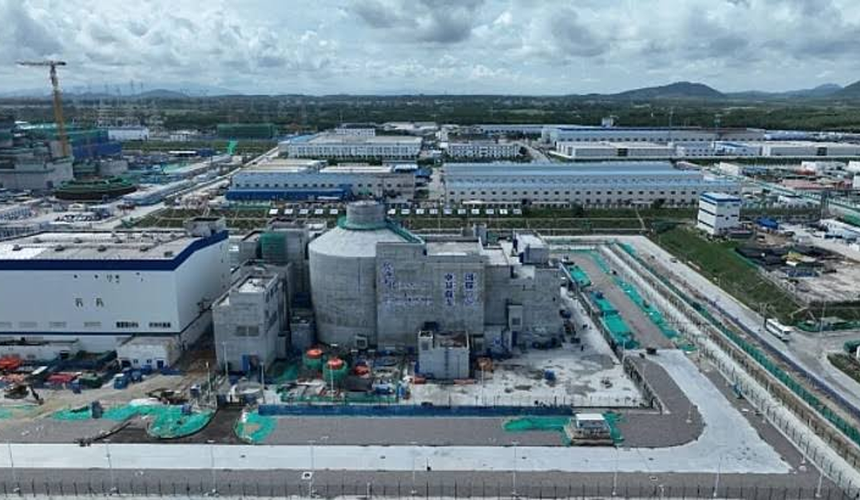
The engineering maturity of the ACP100 is further supported by international safety validation. In April 2016, the reactor became the first SMR design globally to successfully complete the IAEA’s Generic Reactor Safety Review (GRSR). Deploying this technology from blueprint to practice, construction of the world’s first commercial demonstration unit began at the Changjiang nuclear site in Hainan Province, China, in July 2021. Following rigorous initial testing, the project achieved a major milestone by completing high-temperature and high-pressure functional tests of its primary systems, clearing the path toward nuclear fuel loading and grid connection.
Powering Industrialization and Regional Growth Beyond the Grid
For an emerging economy like Ghana, the strategic utility of an advanced small modular reactor extends far beyond generating baseline grid electricity. The ACP100 is engineered as a multi-purpose energy system, capable of simultaneously supplying electricity and high-temperature industrial steam.
This cogenerational capability aligns directly with Ghana’s national industrial drive, which prioritizes local value addition in energy-intensive sectors such as bauxite refining, gold processing, metal smelting, and petrochemicals. These industries require reliable, high-grade process heat alongside heavy electrical capacity. When co-located near primary industrial parks, an SMR can deliver dedicated steam directly to facilities for drying, smelting, and chemical synthesis, thereby providing a stable energy foundation that shields local manufacturers from global fossil fuel volatility and carbon tariffs. As a complementary application, its clean energy output can also support localized seawater desalination to meet supplementary water requirements for coastal industrial hubs.
Together, these applications illustrate how modern SMR technology can act as an integrated engine for socio-economic development, serving regional industrial and municipal ecosystems alongside traditional power generation.
A Pragmatic Reference for Ghana’s Long-Term Energy Mix
With its 125 MWe generating capacity, the ACP100 provides a flexible, scaled nuclear option tailored to the operational realities of developing electrical grids. Unlike traditional gigawatt-scale power plants that impose heavy grid stability demands and immense initial capital outlays, a modular reactor allows power utilities and energy-intensive enterprises to expand capacity in manageable, phased increments. Furthermore, its modular construction philosophy—relying on standardized factory fabrication—reduces onsite construction timelines and mitigates financial exposure.
As Ghana continues to advance its institutional readiness under the IAEA Milestones Approach by progressing through comprehensive site selection, grid impact studies, and regulatory updates, China’s ACP100 project offers a practical, real-world case study. Its design validation, safety review history, and multi-purpose deployment model illustrate how small modular reactors can deliver safe, versatile, and sustainable power to drive Ghana’s industrial ambitions.
Leave a Reply